
How Software Makes Automation Even More Effective
Warehouse Automation Blog

As noted by the 2020 MHI Annual Industry Report, “Embracing the Digital Mindset: Connecting Data, Talent and Technology in Digital Supply Chains,” released at MODEX 2020, the top supply chain challenge continues to be extreme competition for talent (with 57 percent of the survey’s respondents saying their organization struggles to hire and retain qualified workers). That’s closely followed by rising customer expectations for faster, better, and cheaper service.
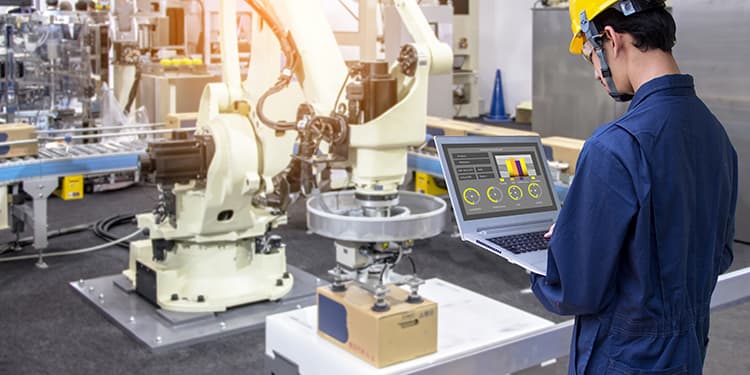
In this challenging environment, adoption of automated technologies and solutions has seen unprecedented growth as operations seek to supplement — and support — their workforce with collaborative robotics, palletizers, mobile sorters, automated storage and retrieval systems, automatic guided vehicles and more to bolster productivity. The key to unleashing the maximum benefit of these investments in automation, however, is software.
As explored in the article “Software that Unlocks the Power of Automation” (produced by MHI’s Solutions Community) featured in the latest edition of MHI Solutions magazine, software — specifically the latest warehouse execution systems (WES) — is the glue that optimizes these automation technologies by taking a holistic view of operations. Unlike warehouse management systems (WMS) that have historically focused on optimizing individual facility zones, WES orchestrates all fulfillment activities and operations within a distribution center (DC), blurring the lines between human and machine while optimizing overall performance.
The article notes that a WES balances work across systems and through all processes and areas, creating a cohesive execution environment. Further, the latest WES packages include the ability to simulate the effect of operational changes, such as a surge in customer demand for a specific item, a shift in inventory profiles, or a significant uptick in stock keeping units (SKUs). By simulating such fluctuations, potential areas of operational weakness can be more clearly predicted, and plans made to augment and supplement those areas.
Additionally, software is enhancing automation in a variety of other ways. Among them:
- Cloud-based hosting, eliminating the need for on-site servers and an extensive commitment from the information technology (IT) department to maintain and update the systems. Further, cloud-based software often incorporates predictive analytics capabilities, allowing operations to anticipate potential equipment failures based on use patterns and schedule preventive maintenance accordingly, eliminating the risk of unscheduled and costly downtime.
- Waveless operations, with software leveraging real-time data about productivity and available manpower to more accurately sequence orders. This enables highest-priority orders to be released first, rather than in pre-scheduled waves. It also eliminates the need for excess mechanization capacity, additional labor as a buffer against unexpected order surges, and less equipment overall — up to 40% less — resulting in a more time- and space-efficient operation.
- Advanced labor metrics, which measure actual productivity of individual employees against the standard for more precise scheduling and greater efficiency in allocating resources.
- Flexible software components, enabling operations to start with only the functionality they need, then add on additional modules that integrate additional automated systems and expand capabilities.
Want to learn more about how software maximizes an investment in automation? The full article, featuring additional insights from MHI members, is posted here.
- #Blog
- #SolutionsCommunity
- #Productivity
- #AMR
- #AMRs
- #Automated Distribution
- #Automated Distribution Center
- #Automated Facility
- #Automated Solutions
- #Automated Warehouse
- #Automation
- #Automation Implementation
- #Autonomous Mobile Robots
- #Digital Supply Chain
- #Flexible Automation
- #MHI
- #MHI Annual Industry Report
- #MHI Solutions Community
- #Robotics
- #Warehouse Execution System
- #Warehouse Management System
- #WES
- #WMS
- #Workforce
View more blogs by:
Related Content

BLOG
Taking A Holistic Approach To Warehouse Resource Optimization Through Software
BLOG
Six Ways Automation Addresses Old And New Labor Issues

BLOG
Software + Machines + Workers = Highly Efficient, Real-Time Decision Making

BLOG


