
Three Ways Autonomous Mobile Robots (AMRs) Are Helping Operations Successfully Navigate COVID-19
Warehouse Automation Blog

The challenges faced by warehousing and distribution operations as a result of the COVID-19 pandemic have been widely reported: staffing challenges with employees absent due to illness, childcare needs, or concerns about contracting the virus at work; implementation of social distancing measures to keep employees safe, yet may impede productivity; and continuous need for thorough disinfection. What hasn’t been covered as much in mainstream media is the ways autonomous mobile robots (AMRs) have been applied (and in some cases reconfigured) to solve these challenges.
Indeed, AMRs are helping a variety of facilities and operations successfully address and resolve the coronavirus challenges in numerous ways. And, despite so many operations closing their doors to outside visitors — including AMR suppliers — many facility managers are able to reroute and reprogram their vehicles without external assistance (or, solely with remote support services) to adapt to COVID-based challenges. That’s because AMR mapping and deployment technology is both intuitive and user-friendly.
Supplementing Staffing
While warehouses face staffing shortages due to absent employees, and staggered or reduced shift scheduling, the demand for order fulfillment — particularly via e-commerce — has increased. To maintain productivity AMRs are being deployed to handle a variety of tasks typically handled by human workers; this enables personnel to be focused on work that brings the most value to the operation. Examples include:
- Cycle counting. Instead of having an associate walk throughout a facility to verify inventory location, quantity, condition, and availability, AMRs outfitted with automatic identification and data capture (AIDC) technologies can be deployed to handle that task. Moreover, because cycle counting can be labor and time intensive, it’s often only undertaken on a quarterly basis. Conversely, AMRs can be programmed to perform cycle counting and other inventory verification tasks around the clock, giving an operation much greater visibility into their entire range of stocked items, and in real-time.
Instead of sending an associate to retrieve cases or pallets of stored inventory for replenishment of pick faces, an AMR can handle the task of transporting the items. Likewise, they can be used to transport components to workstations or work cells on assembly lines.
- Refuse removal. Some operations are using AMRs to pick up trash and recycling at workstations and other designated waste points throughout facilities. The vehicles then transport it to a compactor or other waste collection equipment.
- Transport of picks between associates. To save travel time — often the largest portion of a picker’s time spent during a shift — AMRs navigate from one picker to the next, collecting required items for order fulfillment.
Supporting Social Distancing
Because their travel paths and work areas can be easily modified, AMRs are being used to support and reinforce social distancing. Managers can utilize drag-and-drop mapping via a tablet or other interface to ensure that points of human/AMR interaction are spaced at least six feet apart from other personnel. This minimizes the risk of workers crossing paths.
Chemical and Light-Based Disinfection
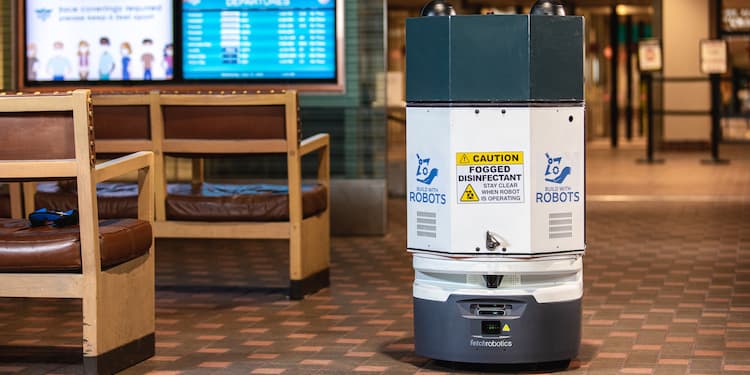
Because many AMRs consist of a base unit outfitted with one of any number of attachments (shelving, roller or belt conveyor, carts), they are easily adapted to a variety of needs. One supplier’s vehicles have been equipped with a unit that sprays a fine mist of a chemical disinfection formula during off-hours. Covering more than 1,000 square feet in 1.5 hours, the AMR provides a deep cleaning of a variety of surface materials and in hard-to-reach areas without requiring a human to be exposed to the mist (which settles quickly and is safe for human re-entry within an hour).
Additionally, another AMR has been outfitted with an ultraviolet (UV) light beam that sweeps over smaller areas, such as workstations, for targeted disinfection. The AMR travels from point to point while the UV beam focuses on high-touch surface areas, including keyboards, door handles, and more. Both types of vehicles can be quickly reprogrammed to travel through different areas and to disinfect other targets as needed.
Looking for more ways AMRs can support warehousing and distribution operations? Connect with the members of the Mobile Automation Group (MAG).
- #Blog
- #MAG
- #SolutionsCommunity
- #Technology
- #AMR
- #AMRs
- #Automation
- #Autonomous Mobile Robots
- #Coronavirus
- #COVID-19
- #MHI
- #MHI Solutions Community
- #Mobile Automation Group
- #Pandemic
View more blogs by:
Related Content
BLOG
Standardized Options Enable Flexible Customization Of Autonomous Mobile Robots (AMRs) For Different Applications
BLOG
Why Pairing Forked AGVs With AMRs Delivers Better ROI
BLOG
Updated Safety Standards For Autonomous Vehicles Detailed In MAG’s MODEX 2020 Education Session
BLOG


