
ASRS Trends: What Businesses Need to Know Now
Automated Storage and Retrieval Systems
Predicting trends in material handling does not require a magic eight ball. Insights in the material handling space can be gleaned from experts in the industry who follow current technology movements and industry regulations and then compare that information with the recent past to develop an outlook for the industry’s future. This attention to detail allows member companies in MHI’s ASRS Group to evaluate what is currently trending so supply chain managers can stay up to date not only with today’s needs, but what they will need in the future. With that in mind, Ed Romaine, Vice President of Marketing and Business Development for Integrated Systems Design (ISD) and a 35-year veteran of the automation industry has seen a lot of change over the course of his career. As ASRS technology continues to advance, he sees three things that material handling and supply chain businesses need to monitor.
New FCC Regulation Regarding Foreign-made Robotics/Mobile Automation
“Any organization looking to invest in ASRS and robotics at this moment would have to do their due diligence and be aware of what they’re buying,” he says. This is because on July 28 of this year, the FCC updated its covered equipment list in Section 2 of The Secure Networks Act. This list covers technological goods that the federal government deems a security risk because of the country where they were manufactured.
When it comes to ASRS devices, Romaine says that while the update mentions robotics specifically, it also targets mobile devices, which can be a grey area when it comes to ASRS technology. He says that ASRS automation isn’t just robotics, and that the ruling could potentially include other movable ASRS technology from fixed-rail cranes to floor-roaming autonomous robots. He believes where various ASRS technologies land on the covered list will depend on how those devices physically move.
“We don’t know how far [the federal government] is going to go yet,” he notes, “but you can look at what they’ve done with drones.” In late 2025, foreign-produced unmanned aircraft systems, aka drones, were placed on the covered list. “There’s a good chance they are going to duplicate what they did with the drones to robots and ASRS.”
The addition of mobile automation devices to The Secure Networks Act is, according to Section 1.50002 of FCC’s Public Safety and Homeland Security Bureau, to protect the U.S. from items “deemed to pose an unacceptable risk to national security…” Romaine advises managers to proceed cautiously when purchasing new equipment and to not only know where the system being purchased is manufactured but know where the components are manufactured as well.
FCC links for additional information:
Built-in Reliability
“Reliability is a major trend in ASRS,” says Romaine. That’s because operators can’t afford to have their systems go down. He says that ASRS companies are building more redundancy and reliability into their systems to help operators avoid downtime and repairs. Building in reliability provides more assurance to the whole system.
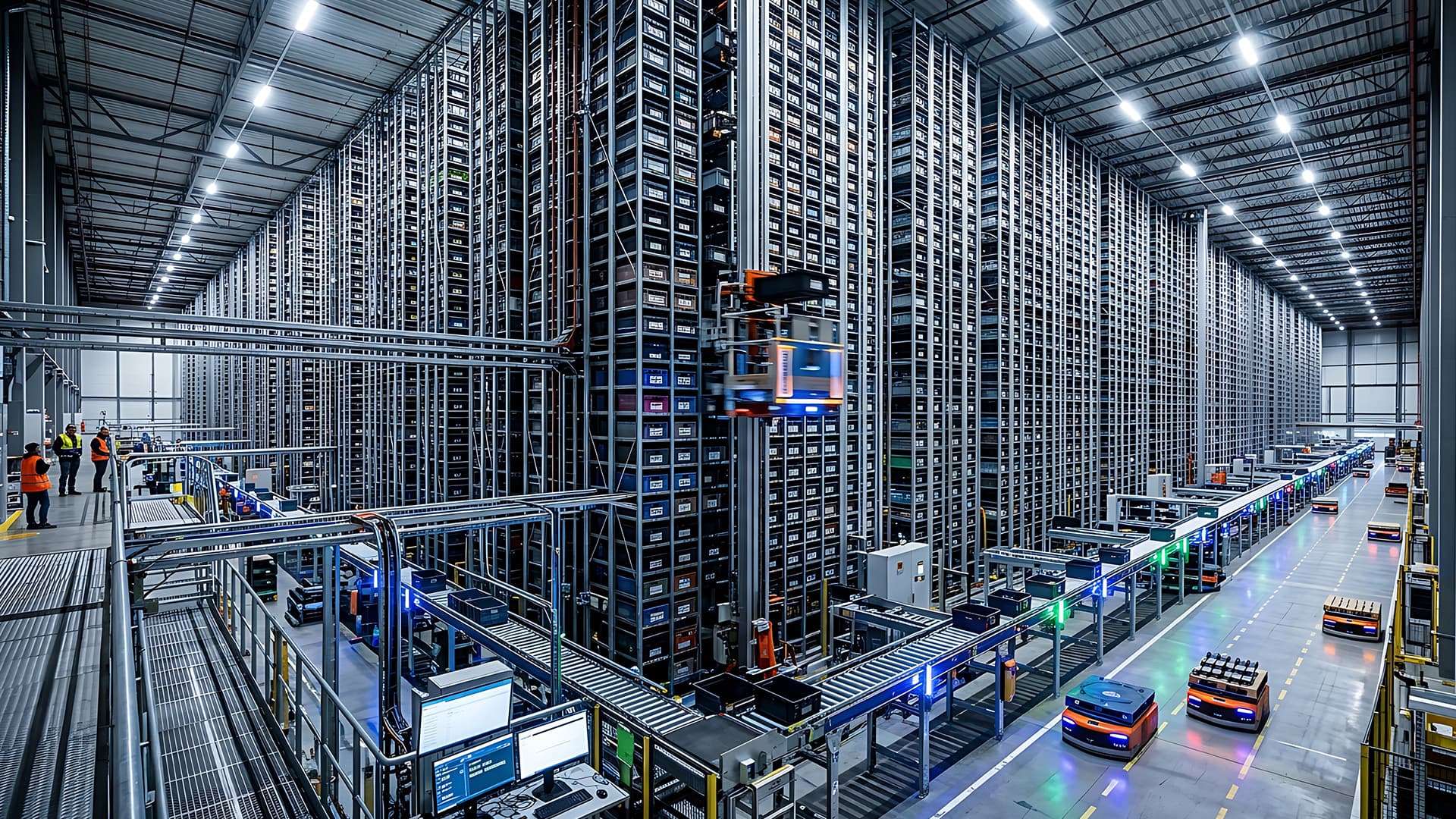
ASRS redundancy typically focuses on single-point failure areas. By addressing these areas early, if a single-point component breaks down, it doesn’t stop the entire system. For example, operations that use crane and aisle ASRS systems now have additional cranes that can be quickly plugged into the application if the original crane is damaged. Other ways to provide reliability include built-in sensors and cameras that provide issue detection in real-time.
ASRS is For Every Business, Large and Small
Advances in ASRS technology now mean that small and mid-size companies have access to the same systems that large corporations have had for decades.
“What it boils down to is that ASRS is more modular than ever,” says Romaine. In the past, in order for these systems to be cost-effective, companies had to buy gigantic systems, which meant that only the largest players in material handling and supply chain could afford it. Today ASRS technology can be designed and scaled to fit a variety of business sizes, which means that small and mid-sized companies are no longer on the sidelines. With carousels, vertical lift modules (VLMs), mini-loads, and high-density storage systems, companies can buy a system to fit their current needs and then add components and systems as they grow.
“The ability to scope and scale has never been like this before,” notes Romaine. “You can continue to add-on robots and infrastructure to make it larger for whatever your future demands might be.”
Have Questions? ASRS Members Can Help
While corporations need to keep their eye on new government regulations, there are exciting trends happening in the ASRS industry. Contact an ASRS member company to learn how ASRS technology can fit your business.
- #Automated Storage
- #Automated Storage And Retrieval System
- #automated mobile robots
- #Vertical Lift Module (VLM)
- #Mini Load
- #storage
View more blogs by:
Related Content
BLOG
Lights Out: The Role of ASRS

BLOG
Podcast: How Does an ASRS Solution Differ and Complement AMRs/AGVs?
BLOG
Cabinet-Free Warehouse Automation: Modular, Scalable Systems
BLOG


