
Warehouse Robotics and WMS Integration: 7 Challenges to Know
SOLUTIONS COMMUNITY
Why Integration Has Become the Biggest Challenge in Warehouse Robotics
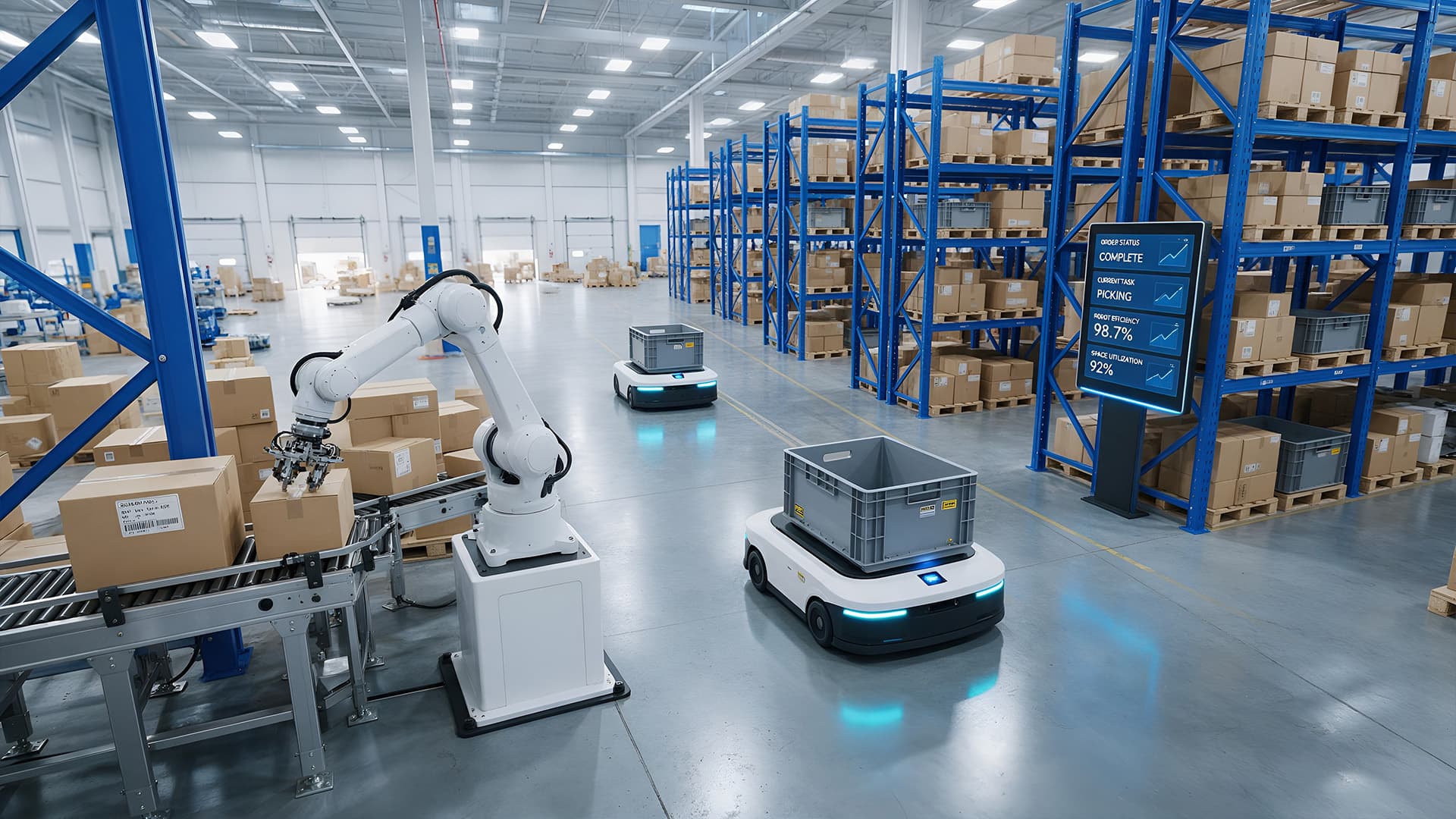
More warehouses and manufacturing facilities are adding robotics automation, most commonly autonomous mobile robots, or AMRs, that move items around a facility. That includes simple pallet movement with autonomous pallet jacks, as well as more advanced systems that support case picking and goods-to-person workflows. In distribution environments especially, most of the value shows up in supporting the order picking process rather than basic transport moves alone.
Companies evaluating this technology tend to focus first on the robots: which vendor, which model, what capacity. That focus is natural, but it often overlooks the bigger issue. The warehouse management system already running the facility, along with any connected ERP, usually was not built with robotics in mind. A layer of orchestration software, sometimes called a warehouse execution system (WES), a multi-orchestration platform (MOP), or a multi-agent orchestration platform (MOAP), has emerged specifically to close that gap. Understanding where the gap shows up is what separates a robotics project that delivers results from one that underperforms even though the equipment works fine. Here are seven challenges companies commonly run into.
Challenge 1: Legacy WMS Platforms Lack the Capabilities Robotics Needs
Most WMS platforms were designed years before robotics automation became common, built around a single order, a single worker, and a single transaction at a time. They typically lack fleet awareness, meaning they cannot see and make decisions for robots working the same zone at once. They lack the dynamic task assignment and workload balancing that robotics requires to stay productive as conditions change through a shift. Balancing and optimizing human and robotic activity is often missing. What often does not materialize is the productivity gain your business expected, because the software directing the work was never designed to coordinate it. This is the core problem robotic orchestration software is built to solve by providing the fleet-level coordination of robots for a warehouse.
Challenge 2: Companies Often Focus on Hardware Before Understanding the Software
A common pattern is buying robots first and treating software as an afterthought, often because the first stop is discussing physical items such as equipment. The result is frequently a rough, back-of-the-envelope estimate of how many robots are needed, based on daily order volume, without much thought given to how those robots will actually integrate with the WMS. Companies can end up with a familiar complaint, the robots are underutilized, sitting idle instead of doing productive work, either because there are too many for the actual need or because handoffs with human workers were never planned for upfront. Much of the return on a robotics investment comes from the software, not the hardware itself, which is why an orchestration platform evaluated alongside the robots tends to produce a stronger and more predictable return.
Challenge 3: WMS Integration Methods Cannot Support Modern Robotics
Traditional WMS and ERP systems were built around flat file transfers and batch processing. That worked fine for human centric operations, but robotic systems typically require modern protocols, such as APIs and web sockets, for bi-directional, millisecond-level communication that a flat file cannot support. Connecting robotics to a system like this generally requires an adapter layer, whether through custom code or a middleware platform built to speak both languages. An orchestration layer built around modern protocols removes the need to write and maintain that custom code for every new robot or system added later.
Challenge 4: Robotics Requires Real-Time Visibility Most WMS Platforms Can't Provide
Robotic systems are autonomous, and a facility can easily scale to many robot types from different vendors. At any given moment, it matters where each one is, its battery status, whether it has stopped, and whether it has been involved in a collision. That level of granular, real-time tracking needs to be captured and acted on by a higher-level system, and most WMS platforms simply are not built to ingest and respond to that kind of real-time data. Orchestration software is built for exactly this, ingesting tracking data continuously and using it to make second-by-second decisions for the WMS.
Challenge 5: Multi-Vendor Robotics Creates an Orchestration Problem
A single robot from a single vendor connecting to a WMS is a relatively contained problem. It gets more complicated the moment a second vendor enters the picture, since vendor software is often not built to support another vendor's robotic activity. That raises a basic but important question: who owns the task? Who decides sequencing, release, and reassignment across a mix of robots, and how do humans fit into the same workflow? Since most operations end up running robots from more than one manufacturer over time, an orchestration engine designed to sit above any single vendor's software is what keeps that mix, and the company's future flexibility, manageable.
Challenge 6: Exception Handling Is Harder Than Most Companies Expect
Real warehouse floors run into real problems. A forklift driver clips a pallet and blocks an intersection. A handful of AMRs from different vendors, queued up in that aisle, suddenly need to be rerouted and reprioritized in real time, or the backlog grows quickly. Handling that kind of situation, reprioritizing tasks and choosing new travel paths on the fly, is well beyond what a traditional WMS is built to do. Orchestration software built for real-time floor conditions can resequence and reassign work automatically, turning what would be a manual scramble into a handled exception.
Challenge 7: Skipping Process Flow Analysis and Simulation Adds Risk
Process flow analysis and simulation are related but different steps, and skipping either one adds risk. Process flow analysis maps how work actually needs to move through the facility, including clustering, task sequencing, and handoffs between robots and people. Simulation then tests that mapped workflow against different assumptions, such as order volume, pick times, or resource mix, to see how it performs before any equipment is purchased. Together, they can help determine how many robots are actually needed, what mix of robot types fits the workload, and where bottlenecks and congestion are likely to occur, often using a facility's own historical order data. They also support evaluating metrics like cost per pick, wait times, travel distance, and localization or Wi-Fi issues, and can factor in multiple shifts and peak demand, since return on investment tends to improve when robotics run across more than one shift. Sophisticated orchestration platforms increasingly build this capability directly, so companies treating automation as a software-first, simulation-first decision can test the plan before committing to hardware.
Middleware and Orchestration Software Offer an Alternative to Replacing the WMS
When a WMS cannot support what robotics requires, companies generally have a few paths: write custom code to bridge the gap, upgrade to a more modern WMS if that option exists, replace the WMS entirely, or add a middleware or orchestration layer that works with the WMS already in place. That fourth option tends to be the least disruptive. It can work with either a comprehensive WMS or a fairly rudimentary one, taking whatever information is available and handling optimization, exception handling, and coordination from there.
This matters especially for mid-market and smaller warehouse operations, many of which run on homegrown or basic WMS systems and assume they need an expensive WMS upgrade before robotics is even on the table. Middleware that connects to existing systems can make automation more accessible to companies that might otherwise rule it out.
Rather than getting caught up in labels, it is more useful to focus on what a given platform can actually do.
What Should Buyers Look for in Orchestration Software?
A reasonable checklist includes:
Support for modern integration protocols, including APIs, web sockets, and proprietary robot protocols(A note on older systems: orchestration software can bridge a lot of gaps, but it depends on the WMS being able to share basic order, inventory, and task data. If your current system can’t do that, a WMS upgrade may still be part of the plan.)
The ability to ingest and act on real-time telemetry
Multi-vendor and multi-type robot interoperability
An orchestration engine that can coordinate tasks across robots and human workers
Process flow analysis and simulation capability to model workflows before and after implementation
Platform agility, so the system adapts to new workflows without custom code for every change
The ability to coordinate with traditional automation, such as conveyors, ASRS, etc. where applicable
Overall software stability, if this is going to be the backbone of your building you need to make sure the uptime and responsiveness of the help desk keeps you at 99.9% uptime.
Successful Warehouse Robotics Projects
Robotics success depends less on which robot a company buys and more on whether the surrounding software, particularly integration, orchestration, and simulation, can support it. Companies that evaluate their WMS, operation processes, and their orchestration options before purchasing robots put themselves in a much stronger position to see their business benefit from the results they expect.
To learn more about evaluating your warehouse for robotics and orchestration software, submit your project inquiry to MHI’s Warehouse and DC Solutions Network and access many of the top robotic orchestration software companies for guidance on one platform.
Contributors: Raj Senguttuvan – Roboteon; Paul Patin – LogistiVIEW
Reviewed by Solutions Community Software Committee
View more blogs by:
Related Content
BLOG
Is It Time to Upgrade Your WMS Systems?
BLOG
Types of Automation Integrators

BLOG
Taking A Holistic Approach To Warehouse Resource Optimization Through Software

BLOG


