
Follow Us


Copyright MHI © 2026 | All Rights Reserved
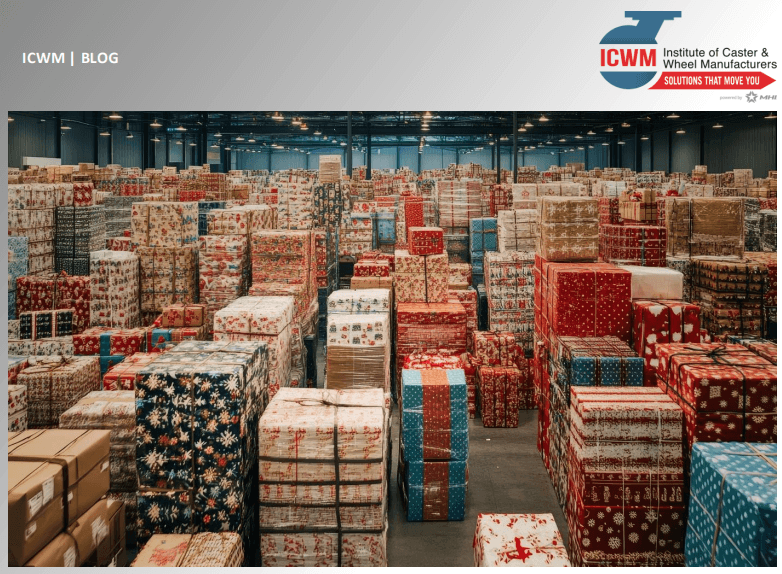
The Season of StrainFrom warehousing to manufacturing to hospitals, workers experience heightened strain when completing tasks, particularly those involving pushing and pulling. Whether maneuvering a material handling cart or a hospital bed, employees’ backs endure stress from high exertion forces. While this is a year-round challenge, the period between Thanksgiving and New Year’s amplifies the risks.Seasonal pressures stem from worsening weather conditions and increased workloads amongst many other factors that lead 2 in 5 companies to see a rise in injuries during the holiday season (OHS Canada, 2024). For example, healthcare workers often operate with a skeleton crew during the holidays, yet patient numbers and thus the demand for patient engagement spikes (Continuing Care Safety Association, 2022). In warehousing and manufacturing, consumer spending surges drive a demand for faster production and delivery. The pressure to ensure customers receive their products on time is intensified by potential postal delays and logistical challenges.From the carts we push to the beds we pull; the holiday season heightens the strain workers face. Effective communication becomes even more essential in these fast-paced, noisy environments. Misunderstandings Misunderstandings between “no” and “go” in a warehouse or hospital can lead to critical mistakes. Addressing push/pull injury risks, improving operational efficiency, and ensuring clear communication are key to overcoming holiday challenges. The right ergonomic caster can play a significant role in mitigating these issues.Are Your Casters Ready to Handle the Holidays?Here are some ways ergonomic casters help reduce holiday-season hazards:Push/Pull Forces When operators exert significant strength to move a cart, they face a primary ergonomic risk factor: force. Excessive push forces can lead to acute injuries, such as muscle strains, and chronic injuries that develop over time, particularly in the lower back. Ergonomic casters help reduce push/pull forces, including the initial force, the sustained force, and the swiveling force—which occurs when the wheels are perpendicular to travel, often the worst-case scenario. These reductions are achieved through thoughtful design elements and carefully chosen wheel materials integrated into ergonomic casters. Overall Rig Design Components like precision ball bearings and Kingpinless casters promote better ergonomics by decreasing push/pull forces, providing maintenance-free use, and eliminating single points of failure to enhance durability. Some Kingpinless casters’ permit modular designs which allows for adjustments to meet increased seasonal demands. Additional wheels can be added to improve maneuverability and push/pull performance, ensuring operations stay safe and efficient under holiday pressure.Caster Offset Caster offset refers to the distance between the swivel head’s center and the wheel axle. Without an offset, loaded wheels experience direct compression, increasing the force required to move the cart. By introducing a caster offset, the wheel pivots more easily, reducing push/pull forces. However, offset designs must be carefully engineered. Excessive offset can create tripping hazards as the caster extends beyond the cart’s footprint. Additionally, insufficient reinforcement of the offset can lead to deformation under heavy loads. Conversely, over-reinforcing the caster can increase its weight, creating new handling challenges. So, ensure the offset meets the requirements of the task, the environment, and the cart operator.Wheel Material Wheel material significantly influences push/pull forces and other ergonomic considerations. Very hard wheels excel in clean environments with hard flooring, such as concrete, due to their low coefficient of friction. However, in less controlled environments like shop floors, their push/pull performance may decline. Softer, resilient materials are ideal for environments with debris and uneven flooring, where harder materials often fail. The lower durometer wheel can absorb the impact of these environmental characteristics. Loud environments, whether in hospitals or distribution centers, can compromise safety and efficiency. Ergonomic casters with noise-reducing materials absorb shocks and reduce noise, addressing common secondary ergonomic risk factors while not being impeded push/pull performance. These materials promote safer, more efficient workplaces, ensuring smoother operations during the busiest time of year, particularly when housekeeping is less frequent.Not all wheel materials perform equally across facility environments. While improving push/pull performance is critical, it’s also essential to account for other ergonomic and operational risks when selecting the right wheel material.Wrapping It UpThe holiday season brings heightened demands and increased risks for workers across industries. Ergonomic casters can significantly reduce these risks by lowering push/pull forces, improving cart maneuverability, and enhancing communication through noise reduction. Selecting the right wheel material is critical to optimizing caster performance. Investing in ergonomic caster solutions ensures that your workforce remains safe, productive, and ready to handle the holiday rush.

Heavy lifting, repetitive motions & hazardous areas, the potential for workplace injuries is significant– automation mitigates these dangers.
Click Here to Read More

Click Here to Read More