
Follow Us


Copyright MHI © 2026 | All Rights Reserved

A complete AGV System utilizes the components outlined in “Introduction to Automatic Guided Vehicle Systems,” as well as on-board technologies, to maneuver loads safely throughout a facility from one location to another.
The objective of the white paper is to develop a marketing plan targeting soft/hard benefits of AGVs that will greatly expand recognition, awareness and knowledge of AGVs in markets. Therefore, our goal in this study is to overview today’s technologies used in AGVs to keep current and potential
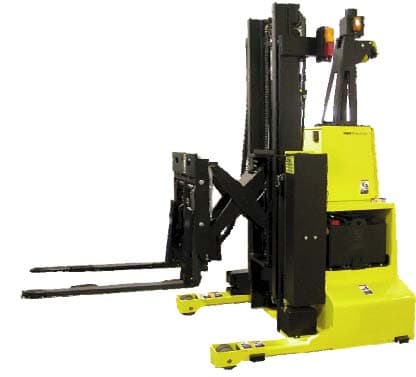
An automatic guided vehicle system (AGVS) was successfully implemented at a major pharmaceutical company to automate movement of finished product pallets. The guided vehicle picks up the finished goods pallet and delivers it to an available flow rack. Forklift operators then take the finished goods pallets from the flow racks and place them on to the stretch wrapper. The efficient system provided the safe, reliable and timely delivery of finished goods. AGVs are a flexible solution for plants changing production demands.
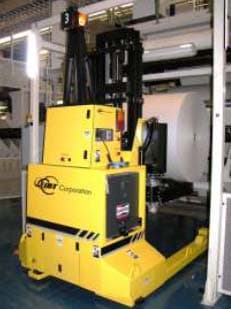
A fleet of three forked automatic guided vehicles (AGVs) transport, load and unload rolls of stripped and pasted newsprint from a semi automatic roll preparation station to six printing press reel stands.
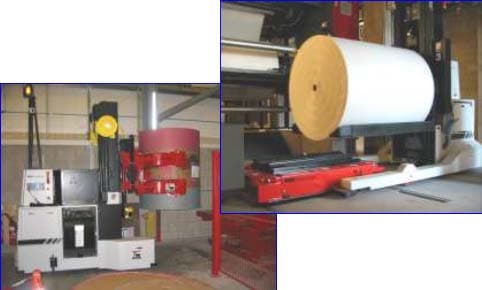
A system of three (3) automatic guided clamp vehicles (AGVs) picks up reels from the receiving area and delivers to storage. When the facility signals a new press run, the clamp vehicles automatically pick up reels from the storage area and deliver vertically to the reel tipper unit.
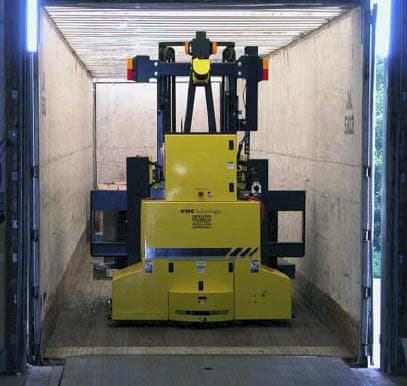
An automatic guided vehicle system (AGVS) was installed to automatically load trailers in a juice beverage plant. Pallets are picked up directly from conveyors at the exit of the palletizing lines and then delivered into standard, over-the-road trailers. The system needs no special dock equipment and is scaleable so larger and smaller throughputs can be accommodated by adjusting the number of vehicles. The installation significantly reduced labor cost and product damage.

An Automatic Guided Vehicle System, or AGVS consists of one or more computer controlled wheel based load carriers (normally battery powered) that runs on the plant floor (or if outdoors on a paved area) without the need for an onboard operator or driver. AGVs have defined paths or areas within which or over which they can navigate. Navigation is achieved by any one of several means, including following a path defined by buried inductive wires, surface mounted magnetic or optical strips; or alternatively by way of inertial or laser guidance. See also SGV , Self Guided Vehicle , Unit Load AGV , and/or Tugger AGV .
A Self-Guided Vehicle (SGV) is an autonomous, self-directed robotic delivery system for the movement of product in diverse environments. An SGV operates independently to navigate around fixed and moving obstructions without the need for an external guide path network or sensors, such as buried wires or mounted magnetic or optical strips. Instead, an SGV uses on-board sensory inputs and navigational software to dynamically plot a path as the robot moves to each goal or task destination. See also AGV or Automatic Guided Vehicle or AGVS .
An Automatic Guided Vehicle System, or AGVS consists of one or more computer controlled wheel based load carriers (normally battery powered) that runs on the plant floor (or if outdoors on a paved area) without the need for an onboard operator or driver. AGVs have defined paths or areas within which or over which they can navigate. Navigation is achieved by any one of several means, including following a path defined by buried inductive wires, surface mounted magnetic or optical strips; or alternatively by way of inertial or laser guidance. See also SGV , Self Guided Vehicle , Unit Load AGV , and/or Tugger AGV .
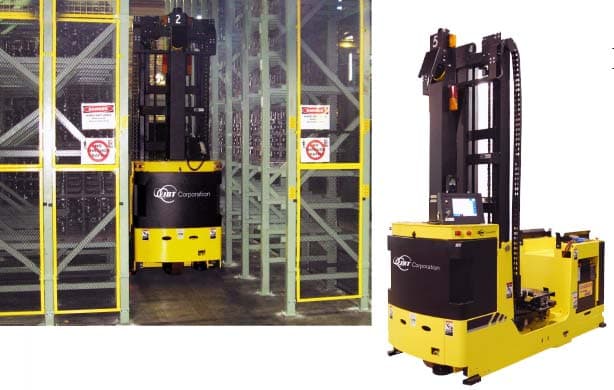
An Automatic Guided Vehicle (AGV) system consisting of seven side loading vehicles with a telescopic platform replaced an existing AGV system at a major automotive manufacturing plant. The system facilitates movement of pre and post heat treated machined parts baskets.
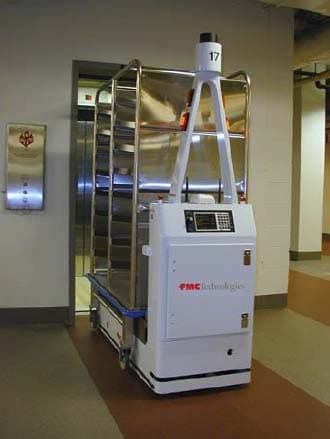
An 11-story, 1,000+ bed hospital installed an automatic guided vehicle system (AGVS) to pickup and deliver materials (meal trays, surgical supplies, pharmaceuticals, etc.) to approximately 500 different points throughout the facility. Each of the 43 vehicles can lift and transport loads weighing as much as 1,000 lbs. They make 3,000 material movements daily interfacing with nine dedicated freight elevators. The AGVS replaced an obsolete overhead rail transport system and provides a cleaner, safer and more organized environment.
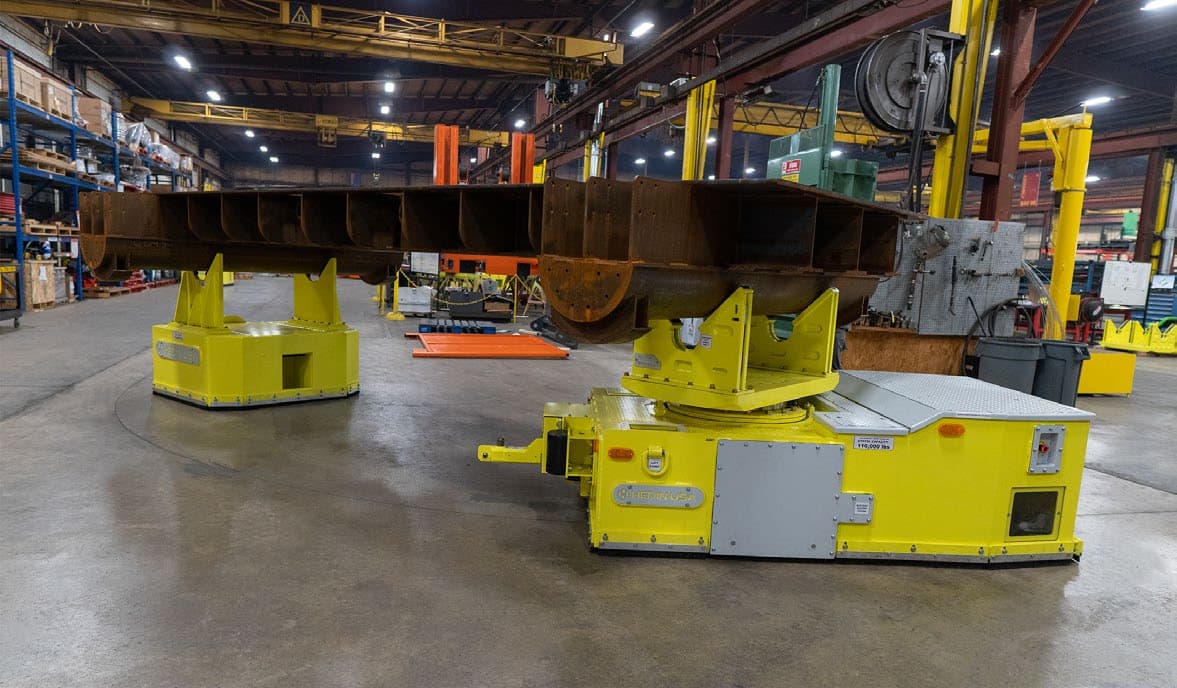
An agricultural company, renowned for its innovative approaches to farming machinery, identified a need for an efficient method to move their newest tractor through various assembly stages. Recognizing the complexity and the high-capacity requirements of the task, they sought an automated solution to streamline the assembly process.
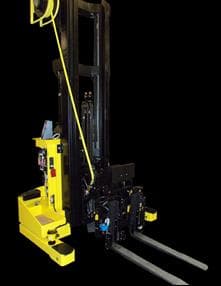
This AGV system operates 20 hours per day, five days per week and facilitates the transport of pallets of product between dock lanes, narrow aisle rack storage, and stretch wrapper in/out.
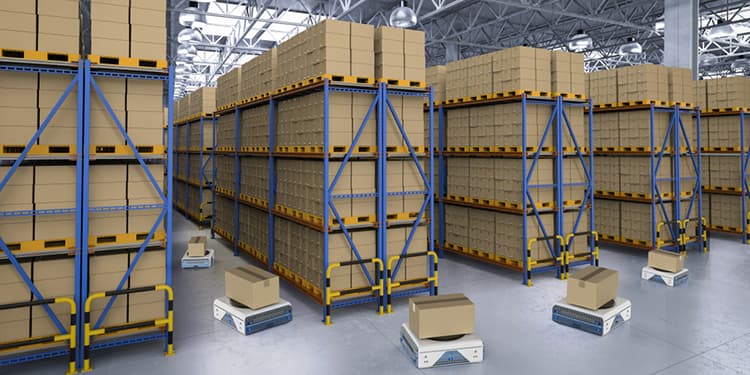
Thinking of investing in an automatic guided vehicle (AGV) system? Then you’re probably also thinking about how to cost-justify its implementation. Although no…
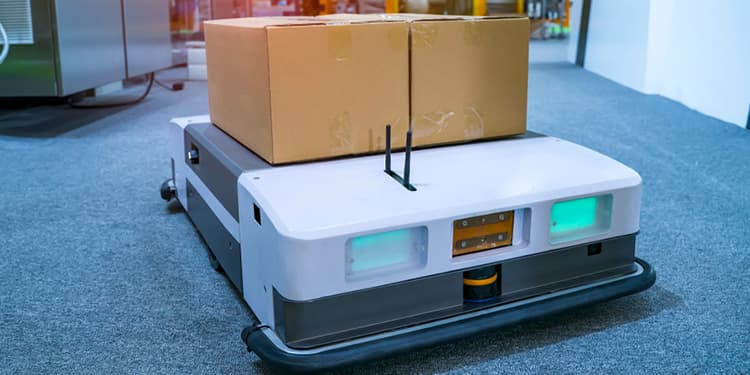
Learn more about the systems that enable automatic guided vehicle systems to navigate as they maneuver loads safely through an operation.

Click Here to Read More
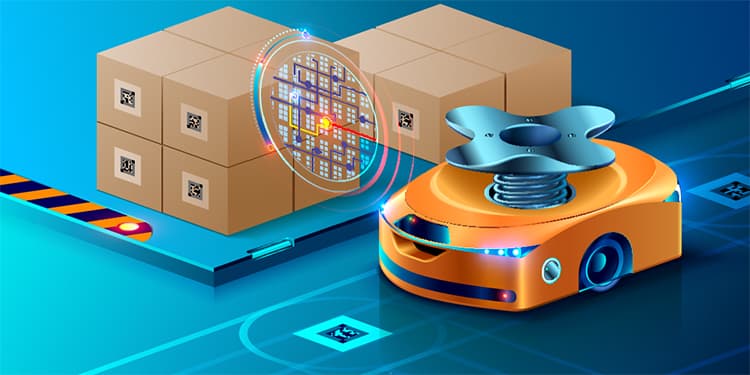
Equipped with redundant safety systems to prevent collisions, automatic guided vehicle systems also deliver a host of other safety benefits.

The Mobile Automation Group (MAG) Industry Group of MHI is pleased to announce the approval of Align Production Systems’, Dematic’s, and UgoWork’s applications to join MAG at the 2023 Annual Conference held October 4th in Fort Lauderdale, FL.MHI member companies have the opportunity to join any of MHI’s Industry Groups or the Solutions Community. Industry Groups share information and conduct research to stay at the forefront of their industry. Typical Industry Group activities include industry statistics collection, standards development, technical publications, public relations, promotion of safety, and member and user education. The Solutions Community brings MHI members together with equipment and systems users to collaborate and address common challenges and opportunities in manufacturing and supply chain in a safe harbor environment.For more information about MHI Industry Groups, please visit mhi.org/industrygroups. To learn more about MAG, please visit mhi.org/mag or contact Jayesh Mehta, Managing Executive, at jmehta@mhi.org.About MAGMobile Automation Group (MAG) members are the industry’s leading suppliers of automatic guided vehicle systems. They supply systems worldwide and in virtually every major manufacturing and distribution sector. MAG member companies meet regularly to review, discuss and revise the standards for design, performance and safe operation of automatic guided vehicle systems. MAG members are committed to the development, maintenance and publishing of industry standard specifications for these systems.About MHIMHI is an international trade association that has represented the material handling, logistics and supply chain industry since 1945. MHI’s over 900 members include material handling and logistics equipment and systems manufacturers, integrators, consultants, publishers and third-party logistics providers. MHI offers education, networking and solution sourcing for their members, the members’ customers and the industry as a whole through programming and events. The association sponsors the ProMat and MODEX expos to showcase the products and services of its member companies and to educate manufacturing and supply chain professionals. The Warehousing Education and Research Council (WERC) is a division of MHI and provides education and research to the warehousing, distribution, and logistics community.
The Mobile Automation Group (MAG) Industry Group of MHI is pleased to announce the recent approval of Crown Equipment Corporation, Cornerstone Specialty Wood Products, Gray Solutions, Murata Machinery USA (Muratec), Pepperl+Fuchs, and Rajant Corporation applications to join MAG at the 2023 Spring Meeting held May 23 in Charlotte, NC.MHI member companies have the opportunity to join any of MHI’s Industry Groups or the Solutions Community. Industry Groups share information and conduct research to stay at the forefront of their industry. Typical Industry Group activities include industry statistics collection, standards development, technical publications, public relations, promotion of safety, and member and user education. The Solutions Community brings MHI members together with equipment and systems users to collaborate and address common challenges and opportunities in manufacturing and supply chain in a safe harbor environment.For more information about MHI Industry Groups, please visit mhi.org/industrygroups. To learn more about MAG, please visit mhi.org/mag.About MAG:Mobile Automation Group (MAG) members are the industry’s leading suppliers of automatic guided vehicle systems. They supply systems worldwide and in virtually every major manufacturing and distribution sector. MAG member companies meet regularly to review, discuss and revise the standards for design, performance and safe operation of automatic guided vehicle systems. MAG members are committed to the development, maintenance and publishing of industry standard specifications for these systems.About MHI:MHI is an international trade association that has represented the material handling, logistics and supply chain industry since 1945. MHI members include material handling and logistics equipment and systems manufacturers, integrators, consultants, publishers and third-party logistics providers. MHI offers education, networking and solution sourcing for their members, their customers and the industry as a whole through programming and events. The association sponsors the ProMat and MODEX expos to showcase the products and services of its member companies and to educate manufacturing and supply chain professionals on the productivity solutions provided through material handling and logistics.

The Mobile Automation Group (MAG), an Industry Group of MHI, is pleased to announce the approval of Hai Robotics’ application to join MAG at the 2025 Annual Conference held October 15 in Tucson, AZ.Hai Robotics, a leading global provider of warehouse automation solutions for inventory storage and order fulfillment, is an MHI member company and has been an active participant of MHI’s Automated Storage and Retrieval Systems (ASRS) Industry Group since 2023.“We’re excited to join the Mobile Automation Group and collaborate with others who are pushing the industry forward,” said Adrian Stoch, CEO of Americas at Hai Robotics. “Our goal has always been to make large-scale automation more accessible to every warehouse, and this partnership helps us continue driving that mission.”MHI member companies have the opportunity to join any of MHI’s Industry Groups or the Solutions Community. Industry Groups share information and conduct research to stay at the forefront of their industry. Typical Industry Group activities include industry statistics collection, standards development, technical publications, public relations, promotion of safety, and member and user education. The Solutions Community brings MHI members together with equipment and systems users to collaborate and address common challenges and opportunities in manufacturing and supply chain in a safe harbor environmentFor more information about MHI Industry Groups, visit mhi.org/industrygroups. To learn more about MAG, visit mhi.org/MAG.About MAGMobile Automation Group (MAG) members are the Industry’s leading suppliers of automatic guided vehicle systems. They supply systems worldwide and in virtually every major manufacturing and distribution sector. Both Automatic Guided Vehicles (AGVs) and Autonomous Mobile Robots (AMRs) are computer-controlled wheel-based load carriers (normally battery-powered) that run on a plant or warehouse floor (or, if outdoors, on a paved surface). The main difference between AGVs and AMRs is how the path they follow is determined: (1) Most AGVs follow predefined paths, although there may be areas of the plant or warehouse where they have more freedom. (2)AMRs can determine their own path, although they will attempt to follow suggested paths if they exist. This difference leads to differing methodologies for ensuring safe operation for the two types of vehicles: AGVs follow the ANSI B56.5 Safety Guidelines and there is a standard under development for AMRs.About MHI MHI is an international trade association that has represented the material handling, logistics and supply chain industry since 1945. MHI’s over 1,000 members include material handling and logistics equipment and systems manufacturers, integrators, consultants, workforce solution providers, publishers and third-party logistics providers. MHI offers education, networking and solution sourcing for their members, the members’ customers, and the industry as a whole through programming and events. The association produces the ProMat and MODEX expositions that showcase the products and services of its member companies to educate manufacturing and supply chain professionals. The Warehousing Education and Research Council (WERC) is a division of MHI and provides education and research to the warehousing, distribution, and logistics community.
The Mobile Automation Group (MAG) Industry Group of MHI is pleased to announce the approval of Slamcore’s application to join MAG as an associate member at the 2025 Fall Meeting held October 13-15 in Tucson, AZ.MHI member companies have the opportunity to join any of MHI’s Industry Groups or the Solutions Community. Industry Groups share information and conduct research to stay at the forefront of their industry. Typical Industry Group activities include industry statistics collection, standards development, technical publications, public relations, promotion of safety, and member and user education. The Solutions Community brings MHI members together with equipment and systems users to collaborate and address common challenges and opportunities in manufacturing and supply chain in a safe harbor environment.For more information about MHI Industry Groups, please visit mhi.org/industrygroups. To learn more about MAG, please visit mhi.org/MAG or contact Jayesh Mehta at jmehta@mhi.org.About MAG Mobile Automation Group (MAG) members are the Industry’s leading suppliers of automatic guided vehicle systems. They supply systems worldwide and in virtually every major manufacturing and distribution sector. Both Automatic Guided Vehicles (AGVs) and Autonomous Mobile Robots (AMRs) are computer-controlled wheel-based load carriers (normally battery-powered) that run on a plant or warehouse floor (or, if outdoors, on a paved surface). The main difference between AGVs and AMRs is how the path they follow is determined: (1) Most AGVs follow predefined paths, although there may be areas of the plant or warehouse where they have more freedom. (2)AMRs can determine their own path, although they will attempt to follow suggested paths if they exist. This difference leads to differing methodologies for ensuring safe operation for the two types of vehicles: AGVs follow the ANSI B56.5 Safety Guidelines and there is a standard under development for AMRs.About MHIMHI is an international trade association that has represented the material handling, logistics and supply chain industry since 1945. MHI’s over 1,000 members include material handling and logistics equipment and systems manufacturers, integrators, consultants, workforce solution providers, publishers and third-party logistics providers. MHI offers education, networking and solution sourcing for their members, the members’ customers, and the industry as a whole through programming and events. The association produces the ProMat and MODEX expositions that showcase the products and services of its member companies to educate manufacturing and supply chain professionals. The Warehousing Education and Research Council (WERC) is a division of MHI and provides education and research to the warehousing, distribution, and logistics community.

This is a paid advertisement.The rise of automated truck pallet loading and un loading has revolutionized how distribution facilities operate – increasing productivity and safety, as well as reducing truck turnaround times. Key amongst these technologies are laser-guided vehicles (LGVs), which are increasingly being utilized for loading and un loading in manufacturing and distribution facilities. The latest evolution of LGVs pack extreme improvements in battery performance, energy utilization, vehicle uptime, CO2 reduction, and enable a more integrated and space-optimized facility, making these LGVs serious systems for truck un loading , staging and loading in any manufacturing or distribution facility seeking to upgrade its operational intralogistics performance.

The Protective Guarding Manufacturers Association (ProGMA) has published a blog to supplement its latest video on safety at pick modules. The video can be viewed at mhi.org/progma/videos.Here at ProGMA, we have produced a series of educational videos on protective guarding equipment in the material handling industry. ProGMA members provide fixed protective guarding products to protect personnel, equipment, and inventory in industrial facilities. A variety of such items are designed for installation at pick modules, which are multi-level structures typically constructed out of pallet rack that allow multiple pallets of product to be stored, broken down, picked, and packaged into specific orders for shipping.Our video is targeted at end users, system integrators, material handling warehouse design consultants / engineers, distributors, and safety professionals in manufacturing and distribution centers in the material handling industry, as well as students studying the sector. Many household and industrial goods we interact with every day were once stored or passed through a pick module. At the distribution centers of companies like CVS Pharmacy and Rite Aid Corporation, for example, goods are stored before being repackaged and shipped to individual stores.As the 2:23min-long video says at the outset, pick modules can have several elevated levels of materials that are handled by both automation and personnel. Although everything in the material handling industry is becoming more automated, separation of full stored cases into smaller, individual shipments is still being completed manually. The size of pick modules has been increasing over the years; in the past, you may have seen a floor plus one level system, then a floor plus two levels, and now it is not uncommon to see three or even four elevated levels. This increases potential hazards.As the video continues, it is of paramount importance that proper guarding is used from the ground up to protect structures, the product they hold and, most importantly, the people working within and around them. Rack upright columns can be difficult to replace and costly to repair because often the area has to be closed off, product has to be removed, and multiple sections need to be disassembled. These components are all dependent upon one another, so if one part fails, the entire system can fail.The video highlights three “easy and affordable” solutions: Free-standing pallet rack column protectors Post cushions Bumper guardsHowever, ProGMA members offer a variety of products for ground-level protection including guardrails, bumper guards, column protectors, bollards, rack guards, and product containment enclosures (i.e., wire mesh or netting); and for upper-level protection, such as side and back product containment enclosures (wire mesh or netting) to prevent products from falling below.What does ANSI say?The video continues, and quotes American National Standards Institute (ANSI) 6.4.3, which states that “…any gate that provides an access opening through the guards for the purpose of loading and unloading material onto a work platform shall be designed such that the elevated surface is protected by guards at all times. Gates that swing open, slide open, or lift or leave an unprotected opening in the guarding are not acceptable.”However, it is important to note that there are many mezzanines that were installed before the ANSI standards were created that used more conventional gates, such as removable, sliding, or swinging systems—and that is the same for pick modules. Systems can be retrofitted to achieve conformity with current standardization. There is no grandfather clause for ANSI (or OSHA) so all systems whether new or old should follow their guidelines. Note that many of the protective guarding products found in the video and on the ProGMA site are easily retrofittable to these older systems.As the video stresses, only dual-gate systems should be used. The same gates used on a pick module are also the preferred method for securing all elevated pallet drop areas whether they are in pick modules, on mezzanines, or on elevated work platforms such as storage or production / blending areas. The ANSI standards that recommended the use of dual-gate systems were written specifically for elevated work platforms and since a pick module is a type of elevated work platform that should be applied.The video demonstrates how a dual-gate system uses two counterbalanced and interconnected gates that are configured so when the first gate at the ledge is open, the second gate behind the pallet is closed. Fixed guarding on the sides—often the frame of the pallet rack in a pick module—prevents access into the side of the areas. This allows material to be loaded into the area while keeping employees a safe distance from the ledge and the material. When the rear / operator gate is opened, the ledge gate automatically closes, maintaining a barrier at the ledge while the pallet is accessed and picked. This creates what ProGMA calls a controlled-access area so there is always a barrier between the worker and the ledge.For information, ProGMA members that manufacture such solutions include Mezzanine Safeti-Gates Inc., Wildeck, and Heartland Engineered Products. Although companies still provide swing gates for pallet drop areas where a single pallet is loaded and staged, they are not an acceptable solution according to ANSI and could potentially create a situation where they are in violation of OSHA code.A self-closing swing gate, also featured in the video, should only be used when integrated with pallet flow lanes where multiple pallets are loaded into the system. The pallet flow lanes are pitched so the pallet rolls into the storage area. This allows the gate to immediately close once the pallet is loaded. By comparison, when used for a single pallet position without flow rails, the staged pallet would hold the swinging gate open, preventing it from closing.For securing multiple deep pallet flow lanes, a dual-gate system is the preferred safety method because not only does it make sure a barrier is in place all times for fall protection, but it also keeps people out of the pallet flow lanes when pallets are being loaded. The two types of incidents we see in these areas are falls from the ledges and pallets being pushed into the legs of employees who have entered the lane. Only the dual-gate system keeps people out of the lanes when the lane is being loaded. The self-closing swing gate, however, does secure the ledge for fall protection.Hand in gloveOftentimes, a safety aspect can be used to increase productivity. For example, the self-closing swinging gate on pallet flow lanes will allow pallets to be quickly loaded into the system. Any time the lift truck operator wants to load a pallet into the area, they just push the pallet through the swinging gates. The dual-gate system has the potential of the gates being in the incorrect position for loading, meaning that the ledge gate is closed when the lift truck is trying to replenish pallets into the area. So they can go to load but a barrier is in place preventing them from doing so.A user can power operate these gates for remote operation but often this isn’t feasible due to the number of areas. Manual operation can actually create a safer and faster environment. The position of the gates in a dual-gate system can be used as a signal between the picker up on the platform and the lift truck operator below. In other words, when the ledge gate is closed that means the picker is picking from the pallets or the area doesn’t need to be replenished.When the picker has finished in that bay or when they notice the pallets need to be replenished in that bay, they just manually close the gate near them, which opens up the ledge gate. Now the lift truck operator can look up and see which areas are safe and ready to be replenished. This is an example of a safety system helping communications among the different workers.In conclusion, it’s evident that, despite automation, people remain at the center of activity in and around pick modules. ProGMA and its members are a one-stop-shop for leading safety solutions, whether it be for preventing hazards associated with falling boxes, product, or workers; or structural protection of the system itself from impact. As the video serves to reiterate, even in automated systems there are still people moving around the facility, either on ground level or on the elevated levels. Even if people are not used for the picking of material, there are areas where empty pallets or totes are removed that need to be guarded.The product-centric video doesn’t feature specific brands, but free-standing pallet rack column protectors, post cushions, and bumper guards are available from ProGMA members including Adrian’s Safety Solutions, A-Safe USA, Bluff Manufacturing, Boplan, DamoTech, Folding Guard, Husky Rack & Wire, Heartland Engineered Products, Jesco, McCue, Slowstop Guarding, SpaceGuard Products, Steel King, Troax, VisiPlas, Wildeck, and WireCrafters.Costs range from inexpensive, light-duty products to more expensive, heavy-duty solutions. Importantly, talking with the manufacturer about the application will help source the right product/s for the facility. No two pick modules or applications are completely alike and that’s what the member companies of the ProGMA are here to help with.The ProGMA website—mhi.org/progma—features details of 22 member companies and hundreds of solutions to help companies with older systems find protective guarding solutions to update / upgrade their pick module system.See the latest video and others in the series at mhi.org/progma/videosShould you be using a ProGMA member to enhance the safety and productivity of your pick modules?About ProGMAThe Protective Guarding Manufacturers Association (ProGMA) members are the industry’s leading suppliers of fixed protective guarding products designed to protect personnel, equipment, and inventory in industrial facilities. Member companies meet regularly to review, discuss, and revise the standards for design and performance of protective guarding products used in the material handling industry. ProGMA member companies are committed to the development, maintenance, and publishing of industry standard specifications for these systems. Visit the website at mhi.org/progma.About MHIMHI is an international trade association that has represented the material handling, logistics and supply chain industry since 1945. MHI members include material handling and logistics equipment and systems manufacturers, integrators, consultants, publishers and third-party logistics providers. MHI offers education, networking and solution sourcing for their members, their customers and the industry as a whole through programming and events. The association sponsors the ProMat and MODEX expos to showcase the products and services of its member companies and to educate manufacturing and supply chain professionals.Contact for editorial enquiries: Ashley Skidmore, askidmore@mhi.org or 704-676-1190