
Follow Us


Copyright MHI © 2026 | All Rights Reserved

First collaborative marketplace for managing commercial pallet supply proves out demand for buying and selling pallets online. Platform finds rapid uptake from midsize to larger enterprises desiring a turnkey “managed service” providing efficient pallet procurement and management, ensuring network visibility and cost-effective supply. Volume throughput doubled every year in operation; planned enhancements and new features for 2026 foreshadow continued growth momentum.SOUTH PLAINFIELD, NJ – MARCH 10, 2026 – When PalletTrader was launched in late 2022 as the industry’s first neutral, collaborative marketplace exclusively for pallets, it promised to bring new efficiencies and connectivity to a procurement experience mired in manual processes. Yet there were some underlying questions as to whether the market was ready for such a leap.Three years later, those questions have been answered unequivocally.“Pallet users were hungry to engage with a platform that gave them digital tools and visibility they’d seen and used in other areas of supply chain, but never before in pallets,” recalls John Vaccaro, president of Bettaway Supply Chain Services and founder of PalletTrader. “What we found almost immediately was a lot of pent-up demand, particularly from mid-size to large enterprises,” he noted. “They wanted us to leverage our vast, digitized supplier network and incorporate a professional managed service that would execute their pallet procurement and operational needs, providing reliable supply at competitive cost. We became their centralized pallet management service.”While the platform is still actively used as a neutral online marketplace by day-to-day users, PalletTrader found the strongest demand to be from business enterprises with multiple manufacturing or distribution sites and that procure at least 50,000 pallets per year per site.Coming out from under the radarPallets historically had been a somewhat “under the radar” aspect of shipping and supply chain operations, lacking the digital transformation which was occurring rapidly across other supply chain activities. “We figured it was a better bet if someone with proven industry experience led development of the platform, rather than a tech player from the outside,” Vaccaro recalled. “Feedback from the user community has validated that. There was a level of trust and confidence that we were bringing deep expertise and operational knowledge to the challenge…and a powerful desire to innovate.”Industry estimates peg the addressable market for white wood pallets at some $7 billion with over 500 million “one-way” white wood pallets in circulation in North America. There are more than 1,500 pallet “depots,” virtually all of which are independent businesses, each of which could have as few as five or as many as 1,000 customers. The cost of a white-wood pallet can range anywhere from $3 to $25, depending on demand, condition, size and material cost.With such a large market, PalletTrader has just scratched the surface, yet Vaccaro is encouraged with its momentum; the platform has more than doubled its volume in each of the past three years.Applying lessons learnedFollowing the initial launch, what Vaccaro and the team quickly learned is that larger players, such as corporate enterprises, wanted more of an all-inclusive managed service.“We discovered a huge selling point and a unique value was our ability to be a neutral procurement and management service, “Vaccaro noted. “We can leverage our network of suppliers or create a hybrid program where we manage their existing incumbents and fold in new suppliers as needed. That flexibility and ability was a big differentiator. And importantly, the customer has visibility over their entire network in one place.”He added that an immediate benefit was mid-tier to larger enterprise clients getting their arms around a fragmented process quickly, “so they can ultimately buy better across the market, leveraging their total spend instead of having individual plants do it independently in a vacuum.”The blended service capability also removed a risk factor for local facilities, who were hesitant to move under one management umbrella for fear of losing local control, and damaging existing strong local supplier arrangements.“We lean into being agnostic,” Vaccaro said. “If you want to keep all or some of your supplier partners in place, we welcome it. We understand the value of long-time partnerships. PalletTrader merely becomes the management arm that tenders and manages the loads.”“Not to mention those incumbent suppliers most likely already are PalletTrader partners,” Vaccaro added. “Local managers can keep them in play while corporate gets total visibility to their pallet demand and supply flow across their entire network,” he explained. “If a supplier raises their price or fails on quality, we can quickly collaborate with the team and replace that provider with another supplier to assure consistent supply across the network, at the best possible cost.”Essentially PalletTrader removes the need for a business to assign someone to handle pallets. Vaccaro said. Most of the time pallets fall under the purview of a Chief Procurement Officer who is responsible for huge amounts of all indirect spending. “Pallets is just one small piece of that, and many times it’s hard for them to get it under control. Our expertise is leaning into the data and deep industry knowledge, understanding the market and constantly monitoring the market on behalf of the client so they don’t have to,” he emphasized. “Our foundation of pallet operations allows us to act as a bridge between procurement and the facility operators which makes our management service easily accepted by all parties involved.”Looking to the futureUser feedback also led to other feature/function refinements, adjustments, new tools and features. Among those: Removal of seller fees making PalletTrader free to the supplier industry. Implementing an integrated supplier buy-back program, under the managed service option. Enabling pallet inventories listed on the marketplace to be viewed by all. Adding a guest user role so users could make immediate point-of-sale purchases direct from the market without first registering. Refining workflows and processes and reducing the amount of “clicks” to transact. Redesigning user screens further simplify and streamline the user experience.Vaccaro says that PalletTrader will continue to evolve and make adjustments and improvements to the platform and service that meets the demand. The team also is evaluating opportunities for added services and expanded capabilities that would increase the value of the platform for the pallet community. It also plans to expand resources devoted to the managed service program in response to increasing interest from larger enterprises.Among the initiatives currently planned for 2026 are expansion of PalletTrader into Canada (slated for 2Q 2026) and providing a discount payment program option to sellers so they could have flexible terms and receive payments quicker.Interested parties can sign up and begin using the platform at www.pallettrader.com, or for more information call (877) 777-7495 or email support@pallettrader.com.About PalletTrader & Bettaway Supply Chain ServicesSouth Plainfield, NJ-based PalletTrader is transforming the way businesses handle pallet procurement and order management. Leveraging seamless technology, PalletTrader provides comprehensive pallet solutions spanning a wide spectrum of services. Their fully managed service offers a centralized management solution, simplifying fragmented processes and enhancing network visibility. PalletTrader’s self-service solution offers a centralized marketplace empowering both buyers and sellers of pallets with more control, convenience, and choice. Trust PalletTrader to reshape your pallet needs- where innovation meets practicality. Bettaway, who founded PalletTrader, is an integrated material handling, transportation, and supply chain management company. Bettaway is an industry leader in pallet management solutions, delivering a managed service program built on an active network of some 750 facilities, and an active supplier database of 1,200+, providing a centralized suite of pallet services. The company also provides quality transportation with its own dedicated fleets on both the east and west coasts, a national 3PL network, and a full-scope warehouse operation with a variety-pack line, e-commerce fulfillment and distribution management for beverage and other CPG products, as well as supply chain consulting services.ContactGary FrantzBettaway/PalletTradergary@gnfcomms.com(925) 594-1434
This pallet presents itself as a sturdy all-rounder among heavy-duty pallets: the newly designed E3-5 from Craemer. Like all load carriers from the Germany-based Craemer Group with more than 60 years' experience in plastics processing, it is made of durable, high-quality polyethylene and has a robust construction – which means a long service life, even with a high number of trip rates. Manufactured in one piece, it features a very high load-bearing capacity and excellent bending stiffness. As a result, the E3-5 pallet could become indispensable in the (intra)logistics of many industries in the future.In 1967 Craemer revolutionized the world market with the very first one-piece injection molded plastic pallet. Today, with its injection-molded polyethylene (PE) one-piece load carriers, the Craemer Group is one of the world's leading manufacturers of logistics solutions. The family-owned company is now launching another innovation – the E3-5 pallet. Even sturdier and with an even higher load-bearing capacity than their reliable all-round D3-5 pallet, the Craemer Group’s E3-5 is an all-rounder in the heavy-duty category – in high racking systems and in the field of automated conveyor technology.Functional all-purpose palletThe new E3-5 has been designed as a 4-way all-purpose pallet in industrial dimensions (47.6 x 39.8 x 6.3 inches / 1200 x 1000 x 160 millimeters), with a tare weight of 54 lbs / 24.5 kilograms. Including its five runners, the pallet is injection-molded in one shot from high quality PE and 100% recyclable. This versatile plastic pallet is also available as a three-runner version (E3).Another special feature of the newcomer: The E3-5 is a heavy-duty pallet with a purist, functional design. The Craemer design team has deliberately dispensed with additional extras such as Palgrip® anti-slip strips on the upper deck or welded (anti-slip) runners, as these are not necessary for certain applications. On the other hand, the down-to-earth E3-5 pallet has strong features: Thanks to its thick walls and extremely robust design, it is very stable and reliable, shock-resistant and has a high load-bearing capacity.High bending stiffness thanks to steel profilesIts strength lies in its reinforcement profiles: Thanks to six metal profiles (four lengthwise and two crosswise), the E3-5 pallet has a high load-bearing capacity of 3,100 lbs / 1,400 kilograms in high rack (just like the CR3). Thanks to the two crosswise profiles, it is also extremely stable and robust along the short sides. The steel profiles visible on the upper deck, which are not fully enclosed, ensure a very high level of bending stiffness.The heavily ribbed design of the runners also ensures extremely high robustness, resistance and therefore a long service life. This is further enhanced by the straight centre runners, which have neither recesses nor notches: They provide a stronger connection to the pallet body and protect the runners from breaking and cracking when under stress. This means that from the outset, the design avoids local stress peaks caused by notches that would reduce the strength of the body (notch effect).Load safety guaranteedTo ensure that loads are optimally secured, the plastic pallet has a 0.2 inches / 5 mm outer r im as standard. Optionally, it is also available with a 7 mm (0.3 inch) or 22 mm (0.8 inch) rim. The pallet's slight oversize of a maximum of ten millimeters prevents damage to the load, e. g. cardboard boxes, as they do not rest on the rim. In addition, the E3-5 pallet has corners lugs on all four feet, i.e. non-slip retaining ribs for anchoring shrink wrap film.Chamfered edges on both sides of all runners ensure optimum handling with forklift trucks. The E3-5 and E3 pallets can be fitted with twelve Palgrip® anti-slip clips to prevent slipping from the forks during forklift transport. These are clipped into the entry openings in the lower deck.Features and optionsTransponder pockets on each right foot on the long side of the new pallet allow retrofitting with an RFID tag for efficient tracking. On request, the E3-5 pallet can be fitted with recessed fields for barcode labels. Depending on the ordered quantity, printing options such as hot stamping of lettering, logos or numbering on the outer feet of the long side are also possible. Like all Craemer plastic load carriers, the new E3-5 pallet features a very high temperature resistance: It can withstand fluctuations from -22 °F to +104 °F and even up to +194 °F for short periods.Versatile applicationsAs a universal pallet for heavy loads, the E3-5 is designed for a wide range of applications and can be used in the logistics processes of many sectors and industries. Thanks to its robustness and versatility, this new all-rounder for heavy-duty applications will also prove ideal for pooling. In short: the innovation made by Craemer is suitable for a wide range of applications – from high racks to automated processes.With a load-bearing capacity of up to 3,100 lbs / 1,400 kilograms, it offers maximum dimensional stability, especially in high racks. This makes the E3-5 pallet suitable for all types of packaging (crates, boxes, containers, etc.) in the beverage industry as well as in tire logistics. And in the food industry, it can also be used as a versatile pallet for pre-packed food. In areas where (intra)logistics can do without extensive anti-slip elements, the E3-5 pallet is the perfect alternative with an ideal price/performance ratio.

Versatile Pneumatic, Mechanical, and Electric/Hydraulic Models for Safe, Efficient Pallet HandlingAdvance Lifts, a leading North American manufacturer of industrial scissor lift tables and dock lifts, highlights its PALLET PRO Series palletizers, engineered to enhance ergonomics, safety, and productivity in pallet loading and unloading applications. Available in pneumatic, mechanical, and electric/hydraulic models, the PALLET PRO Series offers flexible solutions for diverse industries, from food processing and manufacturing to automotive, aerospace, and material handling.All PALLET PRO models feature a finger-protected rotating turntable that enables safe, 360° pallet access while minimizing operator strain. A solid platform beneath the turntable shields internal mechanisms from debris and impact damage, ensuring long service life. Built-in fork truck pick-up points beneath each platform make relocation simple without requiring disassembly, allowing facilities to quickly adapt workspaces to changing needs.The Pneumatic Self-Leveling Palletizer features a smooth-operating Firestone air spring that automatically adjusts load height as pallets are built or broken down. A convenient pressure gauge and air bleeder allow precise load positioning for optimal ergonomics. With its free-standing, clutter-free design and no need for electrical or control lines, the pneumatic model is ideal for hygiene-sensitive environments where clean operation is a priority. All pneumatic models carry a 10-year structural warranty.The Mechanical Self-Leveling Palletizer offers a fully mechanical, power-free solution with three powder-coated springs installed at the factory—ready for immediate use, no assembly required. Spring selection can be customized for specific load weights, and the powder-coated finish resists wear and corrosion in demanding industrial settings. The mechanical model is backed by a lifetime structural warranty, making it a long-term, maintenance-free choice.The Electric/Hydraulic Palletizer combines precise vertical positioning with smooth, consistent lifting for loads of any size or weight. Controllers are Underwriter Laboratory listed assemblies, and all units meet applicable ANSI codes for safety and performance. Plugging into a standard 110V outlet, the electric/hydraulic model is ideal for applications requiring exact height control and fine adjustments. All electric/hydraulic units include a 10-year structural warranty.Designed for durability, safety, and ease of use, the PALLET PRO Series is suited for applications in retail, food processing, automotive, manufacturing, material handling, warehouses, aerospace manufacturing, fabricating and metalworking, large-scale printing, and paint environments. Each model provides ergonomic load positioning, enhanced operator safety, and long service life, making PALLET PRO the best-in-class choice for self-leveling pallet handling.For more information, visit advancelifts.com/palletizer-self-leveling-lifts/ or call 1-800-843-3625.About Advance Lifts Established in 1974, Advance Lifts specializes in providing lifts for loading and unloading semis, as well as ergonomically positioning work for line workers and adjusting product heights within manufacturing lines. One of the largest dock lift manufacturer in North America, Advance Lifts operates from a state-of-the-art 120,000 square foot facility in St. Charles, Illinois.Dedicated to delivering top-quality products, including industrial scissor lift tables, industrial turntables, container tilters, container dumpers, work access lifts, powered lifts, multistage lifts, and reciprocating conveyors, Advance Lifts offers the most extensive and finest warranties in each of these categories.
OCONOMOWOC, Wis. — April 13, 2023 — ORBIS® Corporation, an international leader in reusable packaging, announces its 40-by-48-inch P3 reusable pallet completed 280 cycles through the FasTrack life-cycle analysis, giving the P3 over 25 times the life span of a standard 40-by-48-inch whitewood stringer pallet. The P3 pallet is a durable, lightweight, stackable hygienic packaging solution that integrates seamlessly with manual and automatic material handling equipment. Performed by the Virginia Tech Center for Packaging and Unit Load Design, the FasTrack life-cycle analysis uses a multistep handling sequence to simulate rough handling of palletized unit loads. In testing, the P3 plastic pallet completed the sequence for 280 cycles without failure, while the wood pallet averaged failure after only 11 cycles. This proved the P3 is an economical, environmental and efficient alternative to wood pallets that will better help companies achieve their operations’ goals and desired return on investment. ORBIS offers a broad range of pallets, each that meet specific performance criteria in the supply chain. The 40 x 48 P3 pallet is the newest offering and is ideal for moving product loads in the retail supply chain. “Historically, we have seen companies choose one kind of pallet and make it work. As we rise to meet consumer demands, that is no longer the case,” said Alison Zitzke, senior product manager, ORBIS Corporation. “Choosing the right pallet for your application is imperative, and that is why it was so important to us to bring the P3 pallet to market to improve sustainable handling in primary packaging, food and beverage, and consumer packaged goods (CPG) applications. We’re extremely proud of its performance in testing and look forward to seeing operations implement this solution.” The P3 pallet is designed with a low, 5.1-inch height profile, is easily double-stacked in racking systems, and helps maximize transport efficiency. Optional steel reinforcements and grommets add strength and stability, helping reduce load shifting and product damage. Molded handholds allow for easy manual handling, while the plastic flow-through design reduces contaminant spaces and allows for easy cleaning. The four-way forklift entry and stringer bottom allow access from any position and provide easy integration with automated handling systems. The P3 pallet can be manufactured using recycled content and can be fully recycled at the end of its useful life. “Besides just making good sense from a business perspective, incorporating reusable plastic pallets can help companies meet sustainability goals,” Zitzke said. “And because the P3 is fully recyclable, it’s eligible for the Recycle with ORBIS program, in which companies can receive a credit for their future packaging buys. It’s a win-win for everyone in the supply chain.” Media: Click HERE for downloadable images. About ORBIS Corporation With more than 170 years of material handling expertise and 65 years of plastics innovations, ORBIS helps world-class customers move their product faster, safer and more cost-effectively with reusable totes, pallets, containers, dunnage and racks. Using a proven approach, ORBIS experts analyze customers’ systems, design a solution and execute a reusable packaging program for longer-term cost savings and sustainability. Using life-cycle assessments to compare reusable and single-use packaging, ORBIS also helps customers reduce their overall environmental impact. ORBIS is a part of Menasha Corporation, one of the oldest family-owned manufacturers in the United States. As a steward of sustainability, ORBIS is committed to a better world for future generations. Headquartered in Oconomowoc, ORBIS has more than 3,100 employees and 50 locations throughout North America and Europe. For more information, please visit https://www.orbiscorporation.com/en-us/

The Protective Guarding Manufacturers Association (ProGMA) has published a blog to supplement its latest video on safety at pick modules. The video can be viewed at mhi.org/progma/videos.Here at ProGMA, we have produced a series of educational videos on protective guarding equipment in the material handling industry. ProGMA members provide fixed protective guarding products to protect personnel, equipment, and inventory in industrial facilities. A variety of such items are designed for installation at pick modules, which are multi-level structures typically constructed out of pallet rack that allow multiple pallets of product to be stored, broken down, picked, and packaged into specific orders for shipping.Our video is targeted at end users, system integrators, material handling warehouse design consultants / engineers, distributors, and safety professionals in manufacturing and distribution centers in the material handling industry, as well as students studying the sector. Many household and industrial goods we interact with every day were once stored or passed through a pick module. At the distribution centers of companies like CVS Pharmacy and Rite Aid Corporation, for example, goods are stored before being repackaged and shipped to individual stores.As the 2:23min-long video says at the outset, pick modules can have several elevated levels of materials that are handled by both automation and personnel. Although everything in the material handling industry is becoming more automated, separation of full stored cases into smaller, individual shipments is still being completed manually. The size of pick modules has been increasing over the years; in the past, you may have seen a floor plus one level system, then a floor plus two levels, and now it is not uncommon to see three or even four elevated levels. This increases potential hazards.As the video continues, it is of paramount importance that proper guarding is used from the ground up to protect structures, the product they hold and, most importantly, the people working within and around them. Rack upright columns can be difficult to replace and costly to repair because often the area has to be closed off, product has to be removed, and multiple sections need to be disassembled. These components are all dependent upon one another, so if one part fails, the entire system can fail.The video highlights three “easy and affordable” solutions: Free-standing pallet rack column protectors Post cushions Bumper guardsHowever, ProGMA members offer a variety of products for ground-level protection including guardrails, bumper guards, column protectors, bollards, rack guards, and product containment enclosures (i.e., wire mesh or netting); and for upper-level protection, such as side and back product containment enclosures (wire mesh or netting) to prevent products from falling below.What does ANSI say?The video continues, and quotes American National Standards Institute (ANSI) 6.4.3, which states that “…any gate that provides an access opening through the guards for the purpose of loading and unloading material onto a work platform shall be designed such that the elevated surface is protected by guards at all times. Gates that swing open, slide open, or lift or leave an unprotected opening in the guarding are not acceptable.”However, it is important to note that there are many mezzanines that were installed before the ANSI standards were created that used more conventional gates, such as removable, sliding, or swinging systems—and that is the same for pick modules. Systems can be retrofitted to achieve conformity with current standardization. There is no grandfather clause for ANSI (or OSHA) so all systems whether new or old should follow their guidelines. Note that many of the protective guarding products found in the video and on the ProGMA site are easily retrofittable to these older systems.As the video stresses, only dual-gate systems should be used. The same gates used on a pick module are also the preferred method for securing all elevated pallet drop areas whether they are in pick modules, on mezzanines, or on elevated work platforms such as storage or production / blending areas. The ANSI standards that recommended the use of dual-gate systems were written specifically for elevated work platforms and since a pick module is a type of elevated work platform that should be applied.The video demonstrates how a dual-gate system uses two counterbalanced and interconnected gates that are configured so when the first gate at the ledge is open, the second gate behind the pallet is closed. Fixed guarding on the sides—often the frame of the pallet rack in a pick module—prevents access into the side of the areas. This allows material to be loaded into the area while keeping employees a safe distance from the ledge and the material. When the rear / operator gate is opened, the ledge gate automatically closes, maintaining a barrier at the ledge while the pallet is accessed and picked. This creates what ProGMA calls a controlled-access area so there is always a barrier between the worker and the ledge.For information, ProGMA members that manufacture such solutions include Mezzanine Safeti-Gates Inc., Wildeck, and Heartland Engineered Products. Although companies still provide swing gates for pallet drop areas where a single pallet is loaded and staged, they are not an acceptable solution according to ANSI and could potentially create a situation where they are in violation of OSHA code.A self-closing swing gate, also featured in the video, should only be used when integrated with pallet flow lanes where multiple pallets are loaded into the system. The pallet flow lanes are pitched so the pallet rolls into the storage area. This allows the gate to immediately close once the pallet is loaded. By comparison, when used for a single pallet position without flow rails, the staged pallet would hold the swinging gate open, preventing it from closing.For securing multiple deep pallet flow lanes, a dual-gate system is the preferred safety method because not only does it make sure a barrier is in place all times for fall protection, but it also keeps people out of the pallet flow lanes when pallets are being loaded. The two types of incidents we see in these areas are falls from the ledges and pallets being pushed into the legs of employees who have entered the lane. Only the dual-gate system keeps people out of the lanes when the lane is being loaded. The self-closing swing gate, however, does secure the ledge for fall protection.Hand in gloveOftentimes, a safety aspect can be used to increase productivity. For example, the self-closing swinging gate on pallet flow lanes will allow pallets to be quickly loaded into the system. Any time the lift truck operator wants to load a pallet into the area, they just push the pallet through the swinging gates. The dual-gate system has the potential of the gates being in the incorrect position for loading, meaning that the ledge gate is closed when the lift truck is trying to replenish pallets into the area. So they can go to load but a barrier is in place preventing them from doing so.A user can power operate these gates for remote operation but often this isn’t feasible due to the number of areas. Manual operation can actually create a safer and faster environment. The position of the gates in a dual-gate system can be used as a signal between the picker up on the platform and the lift truck operator below. In other words, when the ledge gate is closed that means the picker is picking from the pallets or the area doesn’t need to be replenished.When the picker has finished in that bay or when they notice the pallets need to be replenished in that bay, they just manually close the gate near them, which opens up the ledge gate. Now the lift truck operator can look up and see which areas are safe and ready to be replenished. This is an example of a safety system helping communications among the different workers.In conclusion, it’s evident that, despite automation, people remain at the center of activity in and around pick modules. ProGMA and its members are a one-stop-shop for leading safety solutions, whether it be for preventing hazards associated with falling boxes, product, or workers; or structural protection of the system itself from impact. As the video serves to reiterate, even in automated systems there are still people moving around the facility, either on ground level or on the elevated levels. Even if people are not used for the picking of material, there are areas where empty pallets or totes are removed that need to be guarded.The product-centric video doesn’t feature specific brands, but free-standing pallet rack column protectors, post cushions, and bumper guards are available from ProGMA members including Adrian’s Safety Solutions, A-Safe USA, Bluff Manufacturing, Boplan, DamoTech, Folding Guard, Husky Rack & Wire, Heartland Engineered Products, Jesco, McCue, Slowstop Guarding, SpaceGuard Products, Steel King, Troax, VisiPlas, Wildeck, and WireCrafters.Costs range from inexpensive, light-duty products to more expensive, heavy-duty solutions. Importantly, talking with the manufacturer about the application will help source the right product/s for the facility. No two pick modules or applications are completely alike and that’s what the member companies of the ProGMA are here to help with.The ProGMA website—mhi.org/progma—features details of 22 member companies and hundreds of solutions to help companies with older systems find protective guarding solutions to update / upgrade their pick module system.See the latest video and others in the series at mhi.org/progma/videosShould you be using a ProGMA member to enhance the safety and productivity of your pick modules?About ProGMAThe Protective Guarding Manufacturers Association (ProGMA) members are the industry’s leading suppliers of fixed protective guarding products designed to protect personnel, equipment, and inventory in industrial facilities. Member companies meet regularly to review, discuss, and revise the standards for design and performance of protective guarding products used in the material handling industry. ProGMA member companies are committed to the development, maintenance, and publishing of industry standard specifications for these systems. Visit the website at mhi.org/progma.About MHIMHI is an international trade association that has represented the material handling, logistics and supply chain industry since 1945. MHI members include material handling and logistics equipment and systems manufacturers, integrators, consultants, publishers and third-party logistics providers. MHI offers education, networking and solution sourcing for their members, their customers and the industry as a whole through programming and events. The association sponsors the ProMat and MODEX expos to showcase the products and services of its member companies and to educate manufacturing and supply chain professionals.Contact for editorial enquiries: Ashley Skidmore, askidmore@mhi.org or 704-676-1190
To complement a new educational video, thought leaders representing the Protective Guarding Manufacturers Association (ProGMA), an MHI product group, discuss the importance of protecting personnel, equipment, and inventory in industrial facilities.ProGMA has recently launched the second in a series of videos about the importance of protective guarding products in the material handling industry. The video titled “Proper Safeguarding for Elevated Work Platforms” followed the inaugural, educational video titled, “Essential Safety Barriers for Automated / Robotic Workcells”. (http://www.mhi.org/progma/videos)Here, representatives of member companies expand on the themes explored within the latest video in the group’s first blog.Before we start, says Arlin Keck, corporate research and development engineer at Steel King (a manufacturer of pallet racks, mezzanines and guardrails), it’s important to clarify what we mean by “mezzanine” in this context. “The technical term for what my company and other members make is work platforms. Mezzanine was an old term for these systems; however, the word mezzanine had to be dropped because mezzanine, as defined in the building codes, refers to a specified type of floor within a building structure and carries with it added requirements for fire safety, egress, parking, and so on,” Keck explains.A typical work platform is design to support the site-specific load that will be placed on the floor, be it palletized loads, pallet jacks, foot traffic, work equipment, filing cabinets, racking or shelving units, to name just a few possibilities.Keck says that the main purpose of an elevated work platform is to add additional floor space into a building or room by taking advantage of surplus ceiling clearance that may exist in a warehouse or manufacturing facility. Aaron Conway, president at Mezzanine Safeti-Gates Inc. (a manufacturer of safety gates to secure the ledges of pallet drop areas on mezzanines and rack picking systems), says, “A company that has utilized all of its ground space can build upward. An elevated platform allows one to use the space for workflow or to store product.”As Hue Schlegel, director of marketing at Wildeck Inc. (a manufacturer of mezzanines and work platforms), puts it, “Move up, not out.” He adds, “Depending on the available height in a building, platforms can be one, two, or three levels high, with the most common height being 10 ft. top-of-deck and supporting a floor load of 125 lbs. per square foot. Their length and width are only limited by facility size.” Importantly, he explains, they cannot occupy more than two thirds of a fire-rated area within a building.Keck says work platforms are also used to create catwalks between separated platforms, and to serve as sortation and conveyance areas for mechanized systems. Conway agrees, adding, “Companies that supply elevated work platforms can fabricate them in virtually any configuration. They can be designed to accommodate specific workflow operations or to fit with existing structures in the building.”Industrial buildings are getting bigger and elevated work platforms are scaling up with them. Say, 50 years ago, facilities were much smaller and ceilings lower so there were fewer requirements for elevated platforms. Further, the equipment to load at such heights didn’t exist. Now, the capability of equipment is greater and taller structures are being utilized as a result. Within them, work and storage takes place on multiple levels.These multi-level work platforms present a danger of personnel and objects falling from height.As the latest video warns, the pallet drop area of elevated work platforms can lead to accidents if the ledge is open without adequate guarding. Falls to lower levels cost employers $5 billion annually in compensation claims in the U.S. alone. OSHA reports that it costs on average 16 lost working days per injured employee.Conway says, “Falling from an elevated level, whether it be people or products, is a serious danger and both should be addressed proactively, securing the situation before an incident occurs.” Schlegel adds, “The worst case, of course, is death; while the best scenario is that a worker survives a fall from the typical mezzanine height of 10 ft. sustaining only broken bones, fractures, and other injuries from hitting the concrete floor below. It is a serious matter not to be taken lightly.”Traditional railing or guarding systems are effective at preventing falls from height as long as they include a kick plate that is installed in conjunction with ANSI MH 28.3-2009. Adding netting or expanded metal and safety products to traditional railing systems provides added protection by capturing small objects that might otherwise fall into the work area below.OSHA Standard 1926.502, meanwhile, requires paneling or screening where tools, equipment, or materials are piled higher than the top edge of a toe-board or kick plate. ProGMA members also manufacture both netting and wire mesh panels that comply with that standard.However, David Brentz, chairman of ProGMA and vice president of member company Industrial Netting (a manufacturer of plastic netting), says, “That’s only a minimum requirement; added protection is financially prudent. The cost to install netting or wire screens around the perimeter of an elevated work platform pales in comparison to the cost of a single lost time accident. ProGMA members offer several simple, cost effective solutions to protect employees below loose objects that may fall or be kicked off work platforms.”Conway says, “In the past, properly guarding a pallet drop area or installing netting or wire was something that would be retrofitted, either after an incident occurred or after someone pointed out the issue. Designing proper safety guarding for the structure at the time of purchase makes for a much better fit; when retrofitting, there is often insufficient room for proper guarding and concessions have to be made. But, it is important to note that even if proper guarding wasn’t designed with the structure, it still should be installed. There are companies in the ProGMA that can customize solutions to fit these areas.”He continues, “Don’t confuse luck with judgment. If I visit a facility that was built, say, 20 years ago, I’m sure to find open pallet drop areas or insufficient guardrails. Just because these areas have been around for a while isn’t a reason not to properly secure them. I’ve heard the line, ‘Well, we’ve been doing it this way for 20 years and nobody has gotten hurt’. To that I say, ‘You’ve been lucky!’”Schlegel says, “The biggest safety risk is when a forklift access gate on mezzanine is left open creating a fall hazard for someone off-loading a pallet at the upper level. There are many products, provided by ProGMA members, that prevent the gate from being left open or that keep the operator at a safe distance, which should always be installed.”ANSI says, “Any gate that provides an access opening through the guards for the purpose of loading and unloading material onto a work platform shall be designed such that the elevated surface is protected by guards at all times. Gates that swing open, slide open, or lift up, leaving an unprotected opening in the guarding are not acceptable.”Dual gate systems such as a rolling gate ensure that the operator is separated from the ledge as well as the load. A pivoting gate ensures the operator is never exposed to the ledge and does not require him or her to walk near an open ledge to operate the gate.Unfortunately, sometimes it can take an incident and a facility to be shut down during an investigation for companies to understand the serious financial consequences of a workplace injury. There are many other companies that understand the risks and proactively secure their work areas. These diligent companies end up ahead in the long run:1. They typically get better solutions because they had the time to design them correctly;2. They get a better price because they can take their time and research the solutions;3. Safety solutions are in place before they need them.Conway concludes, “The large majority of people don’t want to get hurt and are not acting recklessly on the job. Typically, they are performing a repetitive operation, and in their process miss a step or push something too far and someone gets hurt. Proper guarding should be in place to prevent injury if this happens.”About ProGMAThe Protective Guarding Manufacturers Association (ProGMA) members are the industry’s leading suppliers of fixed protective guarding products designed to protect personnel, equipment, and inventory in industrial facilities. Member companies meet regularly to review, discuss, and revise the standards for design and performance of protective guarding products used in the material handling industry. ProGMA member companies are committed to the development, maintenance, and publishing of industry standard specifications for these systems. Visit the website at http://www.mhi.org/ProGMAAbout MHIMHI is an international trade association that has represented the material handling, logistics and supply chain industry since 1945. MHI members include material handling and logistics equipment and systems manufacturers, integrators, consultants, publishers and third-party logistics providers. MHI offers education, networking and solution sourcing for their members, their customers and the industry as a whole through programming and events. The association sponsors the ProMat and MODEX expos to showcase the products and services of its member companies and to educate manufacturing and supply chain professionals. http://www.mhi.orgContactAnupam Berry Boseabose@mhi.org704-676-1190
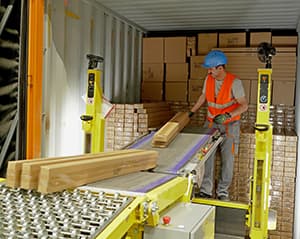
The Challenge: Container unloading is slow At a 104,000 square-meter distribution center in Poland, handling Home and Garden products, container unloading was slow, labor-intensive, and physically demanding. Loose goods made up the majority of inbound shipments, and product variety addedcomplexity to every load.The Solution: Destuff-it™ portable ergonomic conveyor system The operation deployed the Destuff-it™ container unloading system to replace manualunloading with a safer, high-throughput process designed for loose, mixed freight.
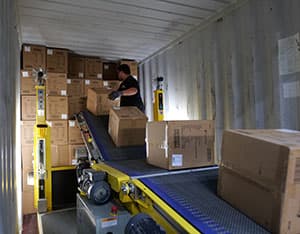
Frogg Toggs, a retail store offering outdoor clothing and gear, faced inefficiencies in container unloading due to manual methods. Their full-spectrum distribution center supports both big-box retail and direct-to-consumer fulfillment. With no associates dedicated solely to container unloading, speed andefficiency are critical—every minute saved gets employees back to their primary roles.The Solution: Destuff-it™ portable ergonomic conveyor system. The operation implemented the Destuff-it™ container unloading system to service four receiving doors. The unit is mobile, allowing it to service all four dock doors.
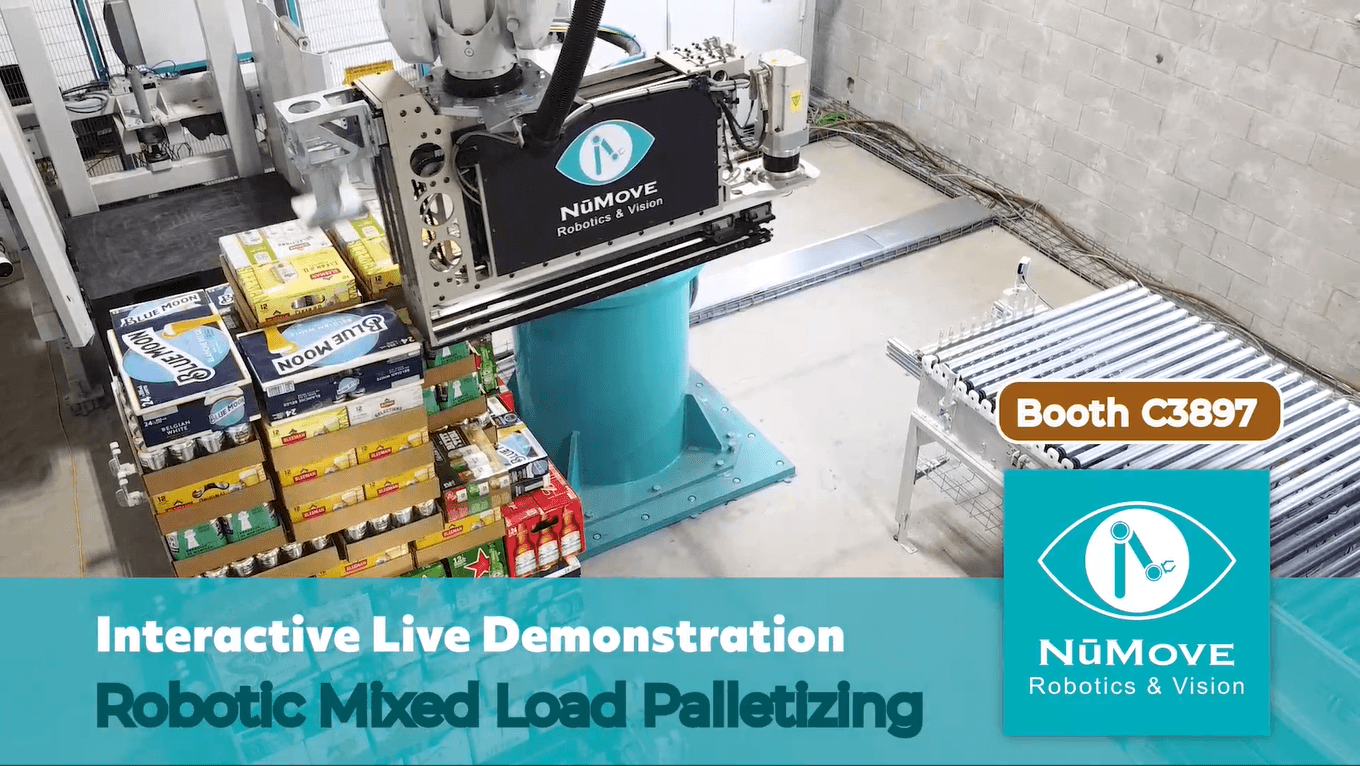
This is a paid advertisement. Seize the opportunity to test NūMove’s Robotic Mixed Load Palletizer during MODEX 2024! At booth #C3897, select a range of products, and witness the palletizing of your custom order in real-time. Immerse yourself in the future of your own facility’s potential and experience how we can help you optimize your outbound operations.
This is a paid advertisement. Discover NūBotik MixPal and InnoPick® — NūMove's latest mixed palletizer and case AS/RS. Seize the opportunity to test these solutions at ProMat 2025! Visit booth S3350 to select products and watch your custom order being palletized in real-time. Register now!

MHI’s second Tech Talk invites two panelists, Arthur Fendel and John Schmidt to discuss pallet racking systems and design for an automated future. Moderator, Jonathan Hirst leads the discussions about some of the hottest topics in pallet racking designs, automation, trends, and more.If you want to learn more live and in-person, join us at MODEX 2024 for the education seminar “Pallet Racking Systems and Design for an Automated Future,” Register Here - Free to attend”For further questions, please contact ateter@mhi.org.
This is a paid advertisement. With the latest technology in high-density, semi-automated storage, Frazier’s Pallet Mole® semi-automated, deep lane racking solution optimizes floor space while measurably enhancing efficiency. Its ability to increase pallet positions and throughput by up to 30%, while also allowing for up to 40% cost savings on labor, adds measurable value to any high volume, low SKU storage operation.
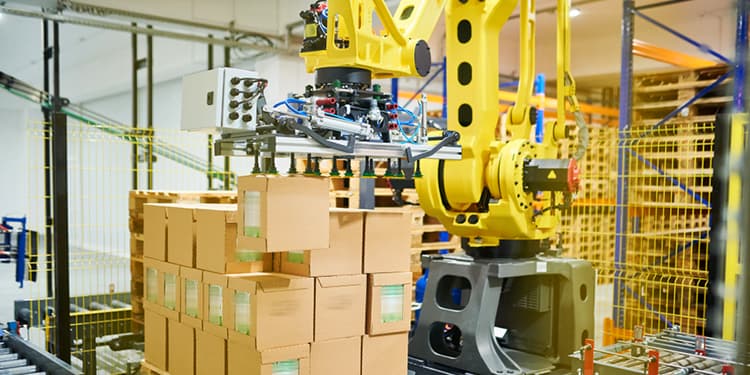
This set of guidelines will help determine if a switch from manual to robotic palletizing is right for a manufacturing or distribution facility.
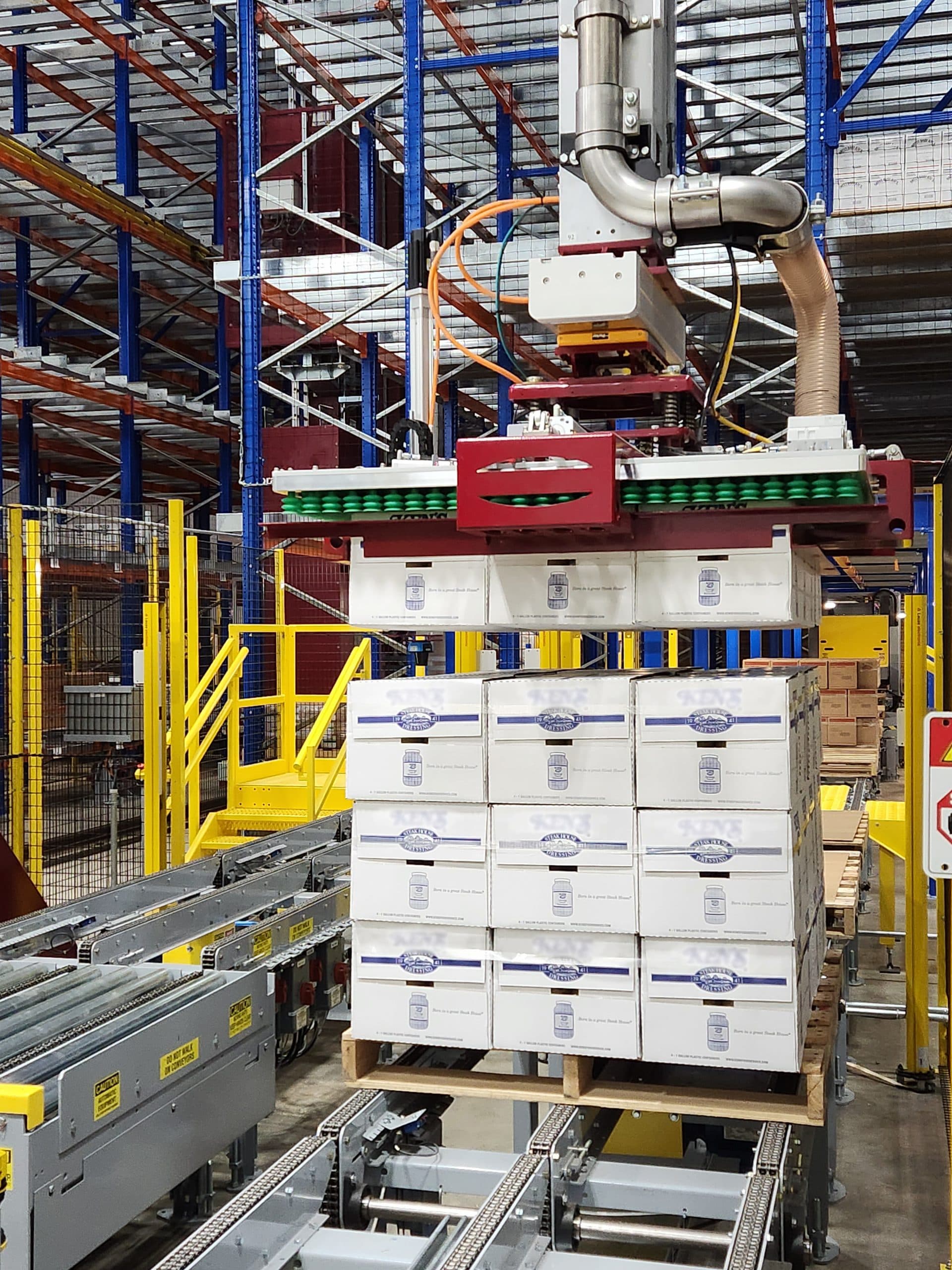
Robotics in manufacturing and warehousing are seemingly everywhere these days, but can they also work in refrigerated environments?
Click Here to Read More

Guest blog by James Riegleman from MHI Member Company ORBIS Corporation...

Palletizers are special machines capable of building a complete unit load on a pallet. Although the most common application is for cases, some palletizers can also handle sacks and bags. A less common palletizer application would be for special products such as sheet stock. There are two general methods employed for automatically building a full pallet. One makes use of a fixed position or overhead gantry robot with end effectors suited to the individual loads, such as vacuum lifts or a gripper. The other method employs more complex mechanisms for forming pallet layers off line, one at a time, and then shifting or transferring each successive layer onto the pallet as it is lowered via a lift/lower table.
Measurement points to determine a pallet's dimensions: Length=distance between pallet ends (inclusive of overhang) and parallel to the stringer(s). Width=distance between pallet sides at right angles to the pallet length inclusive of any overhang Height=distance from the outer edges of the bottom deckboards to the outer edges of the top deckboard. Pallet dimensions are generally shown in inches.
A plastic pallet designed in such a way as to allow the pallet to fit or "nest" in another so as to facilitate better use of storage space. Pallets in which foot design is such that the pallets can stack within each other when empty.
Thermoforming takes place when a thick plastic sheet is clamped onto a frame and heated, then this softened, pliable sheet is forced by either pressure or vacuum to adapt to the shape of a pallet tool. Once the sheet has formed to the configuration of the tool and it has cooled down, it is removed from the frame. The outer perimeter of the pallet is trimmed off to yield the finished part. Twin-sheet thermoforming is a variation of this process whereby two separate sheets of plastic are heated in two separate sets of tooling and then fused together under pressure to yield a pallet with a hollow section or sections.

customers informed, and to provide feedback from AGVs’ stakeholders related to benefits and market of AGVs.
When you’re manufacturing product for a customer, the final step in the packaging process usually to place containers of products onto a pallet for shipping – either to a distribution center or directly to your customer – so it’s a pretty important step. However, manual palletization (employees physically putting containers on pallets) is often considered one of the least desirable activities; the containers are heavy to lift and in many cases the position on the pallet requires extended reaching. It can be a back breaking job and it may even be causing employee safety concerns for the company. But there is another option. Robotic palletizing exists, and it can be a solution for your company.
GUIDELINES FOR DETERMINING MAXIMUM ALLOWABLE LOAD FOR PLASTIC PALLETS IN STORAGE RACK APPLICATIONS - This guideline covers the determination of performance of plastic pallets when used in a standard racking system. The guideline addresses methods of determining a plastic pallet's ability to resist deformation as a result of bending. This guideline is intended for double-faced pallets only.
Small pallets create an opportunity for retailers, but they are not without their challenges, including safe load handling, for those in material handling. Half and quarter pallets present a challenge because they can only be moved with a single forklift tine, but physics and ANSI standards provide the answers to safe small pallet handling.
Bricks and related products come in a variety of types, designs, and colors. But they all have one thing in common: they are heavy. The manual work of loading pallets with finished product involves constant lifting, reaching, and bending. In a typical case, bricks being transported on conveyors were unloaded from the waist-high conveyors onto pallets placed on the floor. Once loaded, forklift trucks move the pallets to storage. Each pallet contains over 400 bricks with loaded pallets weighing in at 2000 pounds. Loading the pallets was time consuming, hard on worker's backs, and led to frequent back complaints, worker fatigue, lost time, and ongoing productivity issues.
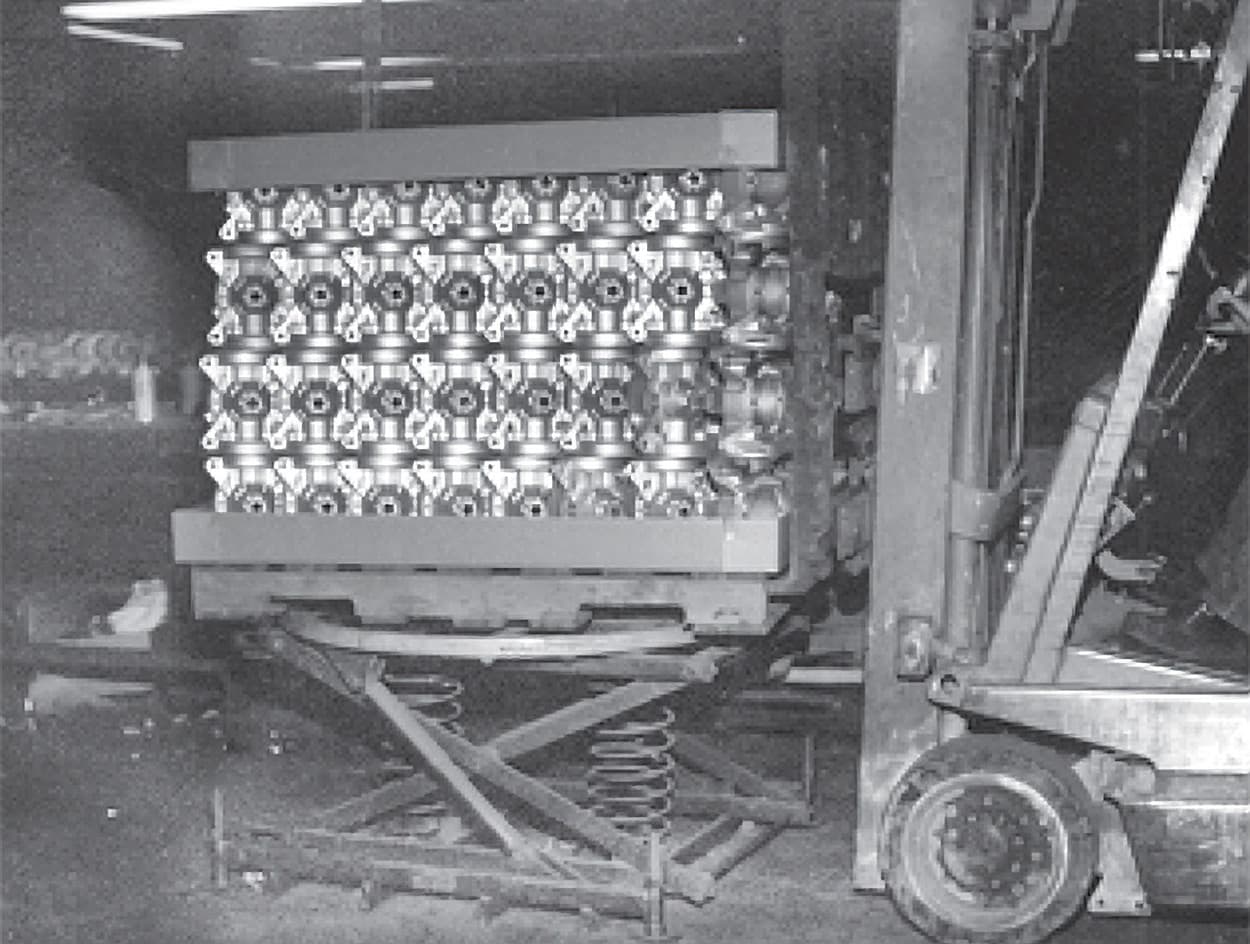
The company in this case study specializes in the design and production of custom aluminum die-castings for a wide variety of industries. The company employs over 300 workers in a 135,000 square foot plant in Texas. Always alert to the well-being of its employees, management was especially concerned with a pallet-loading operation that involved constant stooping and bending as workers loaded finished castings for shipment. The plant manager had this concern in mind when he learned about a piece of equipment known as the Pallet Level Loader.
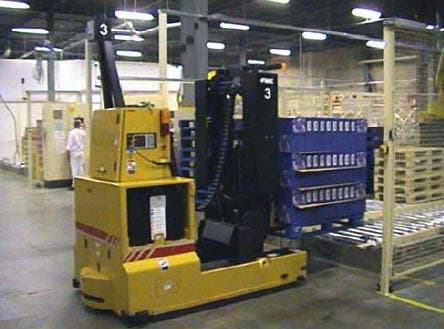
Three automatic guided vehicles (AGVs) has proven to be a safe, efficient way to handle pallets generated by four robotic palletizing lines in this food and beverage warehouse. The use of AGVs eliminated the damage caused by material handling and increased workforce productivity. With the installation of the automatic guided vehicles, the system payback is under two years!
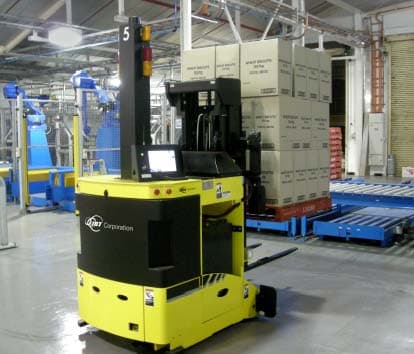
The Automatic Guided Vehicle (AGV) system was installed at a major food manufacturer in New South Wales Australia. The 6 vehicle fleet automates movement of palletized finished product and empty pallets between the stretch wrapper, ten packaging/palletizing lines, a shipping buffer storage area, and two dispatch locations. The dual fork carriage allows the AGVs to transport empty and full pallets simultaneously eliminating the need for pallet dispensers at each packaging line. The system provides for the safe, reliable delivery of food and empty pallets and significantly reduced pallet and product damage.
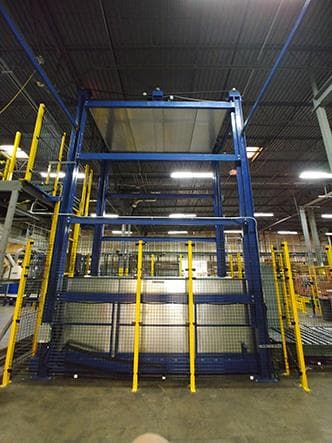
Replace existing lifts with advanced equipment to transport 48” x 40” pallets weighing 350KG vertically (upservice) to a pallet conveyor line that runs across a mezzanine where the pallets transfer to another lift (downservice) where pallets are moved to another pallet conveyor line.

An automation integrator required a pallet labeling system for a new pallet line they were installing. The end-user needed four labels applied to each pallet – two on each adjacent side. One label needed to be printed and applied on demand and the other preprinted product identification label just needed to be applied. The pallet would stop on the pallet conveyor to be labeled.
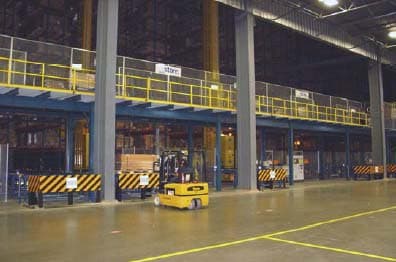
With a new automated storage and retrieval system (AS/RS), this home furnishings distributor has the capability to store over 81,000 pallets. Sizes include Euro (800 x 1200 mm) and customized (800 x 200 mm) pallets. The storage and retrieval machines handle 30 pallets per hour. This provides an overall system throughput in excess of 400 pallets per hour in and out. Along with lift trucks, bar coding and a visualization software package, The entire system provides an extremely efficient and controlled operation.
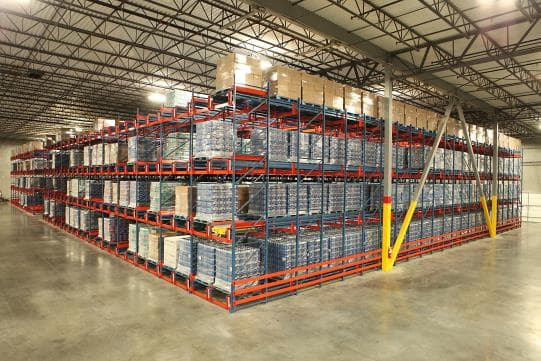
This National Bottled Water Manufacturer supplies many of the country’s largest grocery and warehouse chains with bottled water. With immediate expansion plans underway, they established an ambitious goal for the new turnkey processing and distribution center operation. A versatile 1 to 2-wide Pallet Mole System utilizing a 2-wide Cascade forklift attachment offered maximum density, 100% SKU selectivity and optimal productivity. Working in either FIFO or LIFO applications, the Pallet Mole significantly improves throughput by indexing loads directly to the first pallet position at the aisle face.
Price: $50.00The purpose of this standard is to serve as the guide for designers, manufacturers, sellers, installers, owners, users, and governing bodies of steel mesh containment panels used in pallet rack and vertical storage system applications and to achieve the following objectives:to provide guidelines for the design and testing of steel mesh containment panels used in pallet rack and vertical storage system applications;to promote the understanding of the respective responsibilities of manufacturers, sellers, installers, owners, users, and governing bodies associated with steel mesh containment panels used in pallet rack and vertical storage system applications; andto provide a uniform means of testing steel mesh containment panels used in pallet rack and vertical storage system applications.This standard provides performance and testing requirements for vertically-mounted steel mesh containment panels used in pallet rack and vertical storage system applications to contain and minimize the potential for falling items, protecting personnel, product, and property.
Free download.The purpose of this standard is to serve as the guide for designers, manufacturers, sellers, installers, owners, users, and governing bodies in the design, manufacturing, and use of pallets, slip sheets, and other bases for unit loads. This document is a revision to ANSI MH1-2019, which was a single consolidated standard comprising of 14 separate parts, many of which were written at different times and by different committees. This version is reformatted to incorporate the standard into a single consolidated document.
Price: $150.00This standard specifies minimum requirements for the structural design, testing, and utilization of industrial steel storage racks. It applies to industrial steel storage racks, movable-shelf racks, rack-supported systems, and storage racks associated with automated storage and retrieval systems (ASRSs; also known as “stacker racks”), constructed of cold formed and/or hot-rolled steel structural members. Such rack types also include push-back rack, pallet flow rack, case-flow rack, pick modules, and rack-supported platforms. This standard is also intended to be applied to the design of the storage rack portion of any rack structure that provides support to the exterior walls and roof, except as noted. It does not apply to other types of racks, such as drive-in or drive through racks, cantilever racks (see ANSI MH16.3 for guidance on cantilever racks), portable racks, or racks made of material other than steel.ANSI MH16.1-2023 replaces ANSI MH16.1-2021, which was a revision of ANSI MH16.1-2012(R2019). It updates seismic provisions to align with ASCE/SEI 7-2022, including use of software to obtain seismic data and new methods to obtain the seismic response coefficients. It also includes revisions to the cantilever testing provisions and to the cyclic beam-to-column testing provisions in this section, so that either test can be used to determine beam design spring constants.A summary of the major revisions between the 2021 and 2012 revisions include the following:Reorganization of the document to align with guidance in ISO/IEC Directives, Part 2, specifically moving requirements previously in Section 1 elsewhere in the document, adding Normative References to Section 2 (previously Section 10, “References to the Text”), and adding Terms and Definitions to Section 3 (previously “Nomenclature” in the Foreword);A requirement for post-installation inspection conducted by the owner;New stability design requirements similar to the requirements in ANSI/AISI S100 or ANSI/AISC 360 replace the effective length method for stability design outlined in previous editions;Seismic provisions (7.4) were revised to align with ASCE/SEI 7-2016, including revision of redundancy factors for multiple rows and revision of the Fa and Fv coefficients for the D-Default site class;New design procedure for perforated columns that includes a new definition of net section using reduced strips to represent the hole lines. Torsional properties are now to be calculated using rounded corners and a distortional buckling check is required for those sections subject to distortional buckling. The equation for the Q effect on the column strength has changed;New section on pallet support design;New section on frame tie and cross-aisle tie design; New provisions for base plate and anchor design where the seismic overstrength consideration is required;Interpretation of the cyclic tests for connectors has been added; The base fixity test and frame bracing test have been added;The portal test and the upright frame test in the 2012 revision were removed from the 2021 revision.
Price: $50.00This standard is established to provide a guideline for design, testing, fabrication, and utilization of industrial storage rack decking utilized as an accessory for industrial steel storage racks that conform to ANSI MH16.1, Design, Testing, and Utilization of Industrial Steel Storage Racks. Storage rack decking is placed on beams of industrial steel storage racks to create a surface on which to place materials that can be on pallets, in containers, or in some other form.This standard applies to uniformly loaded storage rack decking applications, as well as various concentrated and partially distributed loading conditions common to storage rack applications. Storage rack decking can be fabricated from welded-wire mesh with permanently attached reinforcements, metal bar grating, composite engineered wood, corrugated metal, perforated sheet metal, or other materials that meet the performance requirements for use in storage racks.This standard does not apply to:Storage rack decking manufactured prior to date of adoption of this standard;Storage rack decking that has been improperly installed, altered, damaged, or used in any manner other than that for which it was originally intended, designed, purchased, sold, or a combination thereof;Lumber not graded or stamped by the Southern Pine Inspection Bureau (SPIB), West Coast Lumber Inspection Bureau (WCLIB), or equivalent grading agency; orStorage rack decking that is intended to support any loads other than product loads (e.g., moving, or live, loads due to walking or stepping).