
Picking The Right AGV For Your Operation Depends On Your Handling Needs
Warehouse Automation Blog

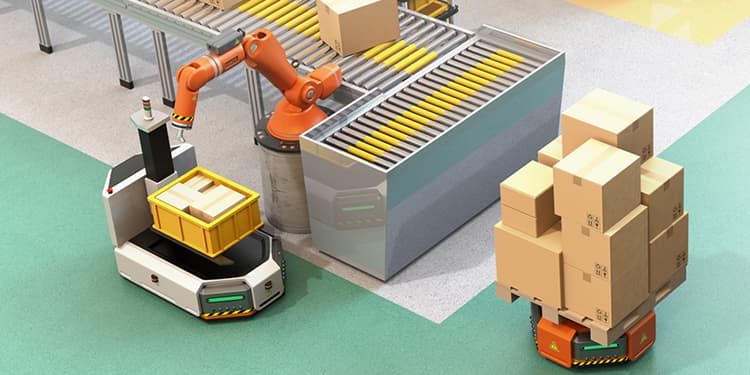
Automatic guided vehicle (AGV) systems are computer-controlled, wheel-based load carriers that travel throughout a manufacturing plant or warehouse (or on pavement outside) to retrieve, transport and deliver loads from one point to another. However, just as no two applications are the same, neither are the AGVs deployed within them. Instead, they come in a variety of configurations to meet unique handling needs, meaning that picking the right one for your operation depends both on the load itself and the type of movement needed.
To help you gain a general idea of the ideal AGV type (or types) for your facility, here’s an overview of each style:
 Fork-Based AGV
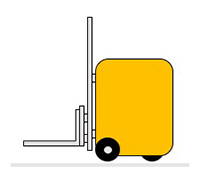
Fork-based Vehicles: These AGVs are outfitted with forks to handle pallet loads. Although they may appear similar to manual lift trucks, AGVs navigate autonomously and are designed to interface with floor and block stacked loads, racking, stands and conveyors. Depending on the application, possible fork configurations include:
- Counterbalanced – For handling of pallets, racks and rolls, these AGVs are equipped with a counterweight to stabilize the load as it is carried by the forks. Overall, they tend to be slightly larger than other fork-based AGVs but with a narrower footprint.
- Outrigger/Straddle – Featuring legs parallel to the forks that extend beyond the width of the vehicle and its load for stability, these AGVs offer a shorter—but wider—footprint than counterbalanced models. They are often deployed to handle pallets, racks and rolls in areas that require more maneuverability.
- Forkover – Ideal for handling open-bottomed containers, such as wire baskets and Euro-style pallets, these AGVs feature two horizontal stabilizing legs aligned directly under the forks. With their compact footprint, these vehicles are highly maneuverable in space-restricted areas.
- Narrow Aisle – Built with an extremely compact footprint to navigate within warehouses and distribution centers with tightly spaced storage racks, these AGVs sport features that permit them to access high-bay racking, such as trilateral turret fork attachments.
- Reach – The forks mounted on these vehicles extend to lift, place or extract a load stored within double-deep industrial pallet racking.
 Unit Load AGV
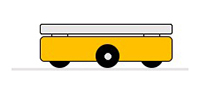
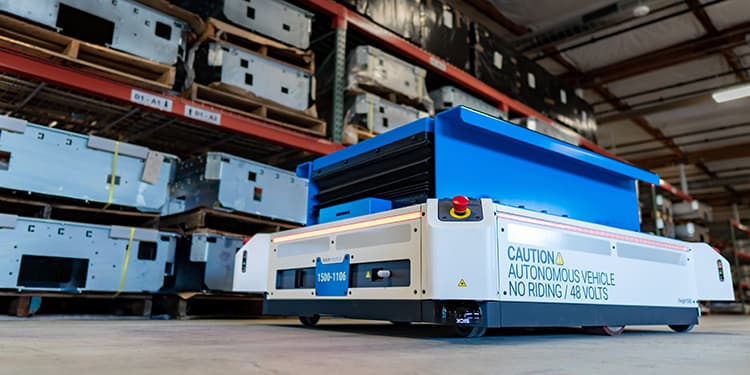
Unit Load Vehicles: Compact and typically low to the ground, these vehicles are loaded/unloaded by external means, as they cannot pick up loads directly from the floor. Sometimes called “top carriers,” these AGVs carry the load directly overhead on either a lift deck or a conveyor deck. They most frequently interface with stands, conveyors or automated storage and retrieval machines (ASRS) to receive or deliver their cargo.
 Tow/Tugger AGV
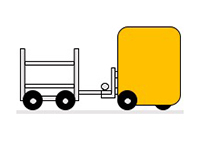
Tow/Tugger Vehicles: Engineered to pull one or more wheeled loads behind it, this type of AGV features either manual or automatic connection to loaded carts. Cost-effective, these AGVs transport multiple cart loads in a single trip. They are frequently deployed in manufacturing operations. Because they move their loads in a “train” configuration, their guide paths are often less complex to accommodate their larger turning radius.
 Cart AGV (AGC)
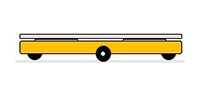
Cart Vehicles: Generally designed to be simpler and smaller, these units—often referred to as automatic guided carts (AGCs)—usually handle loads weighing less than 2,000 pounds. Found most commonly in manufacturing, many of these systems operate in continuous loops with simplified navigation systems rather than being controlled by a host computer. They may either tow or ride under a load.
 Custom Engineered AGV
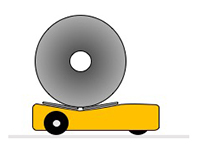
Custom Engineered Vehicles: Completely variable in their shape, size and load capacity, custom AGVs are specifically designed to handle uniquely shaped loads in a highly defined, consistently repeated application or process. They are frequently found in manufacturing to move work-in-process with clamps or roll handling cradles, and in shipping and receiving docks for automatic trailer loading and unloading.
Want more assistance with determining which kind of AGV will best suit your unique application? The members of MHI’s AGVS Industry Group recently published a free white paper, “Introduction to Automatic Guided Vehicle Systems,” with more information.
- #Blog
- #MAG
- #SolutionsCommunity
- #Education
- #AGC
- #AGVs
- #Automatic Guided Cart
- #Automatic Guided Vehicles
- #Automation
- #Cart AGV
- #Custom Engineered AGV
- #Fork-Based AGV
- #Masted AGV
- #MHI
- #MHI Solutions Community
- #Tow AGV
- #Tugger AGV
- #Unit Load AGV
View more blogs by:
Related Content

BLOG
Three Key AGV Functions Controlled By Variety Of Technologies
BLOG
Dispelling 4 Common Misconceptions About AGVs

BLOG
5 Ways AGVs Enhance Safety In Plants, Warehouses
BLOG


