
Container Unloading is the Critical First Step in Digital Receiving
SLAM

Why Container Unloading Deserves a Review
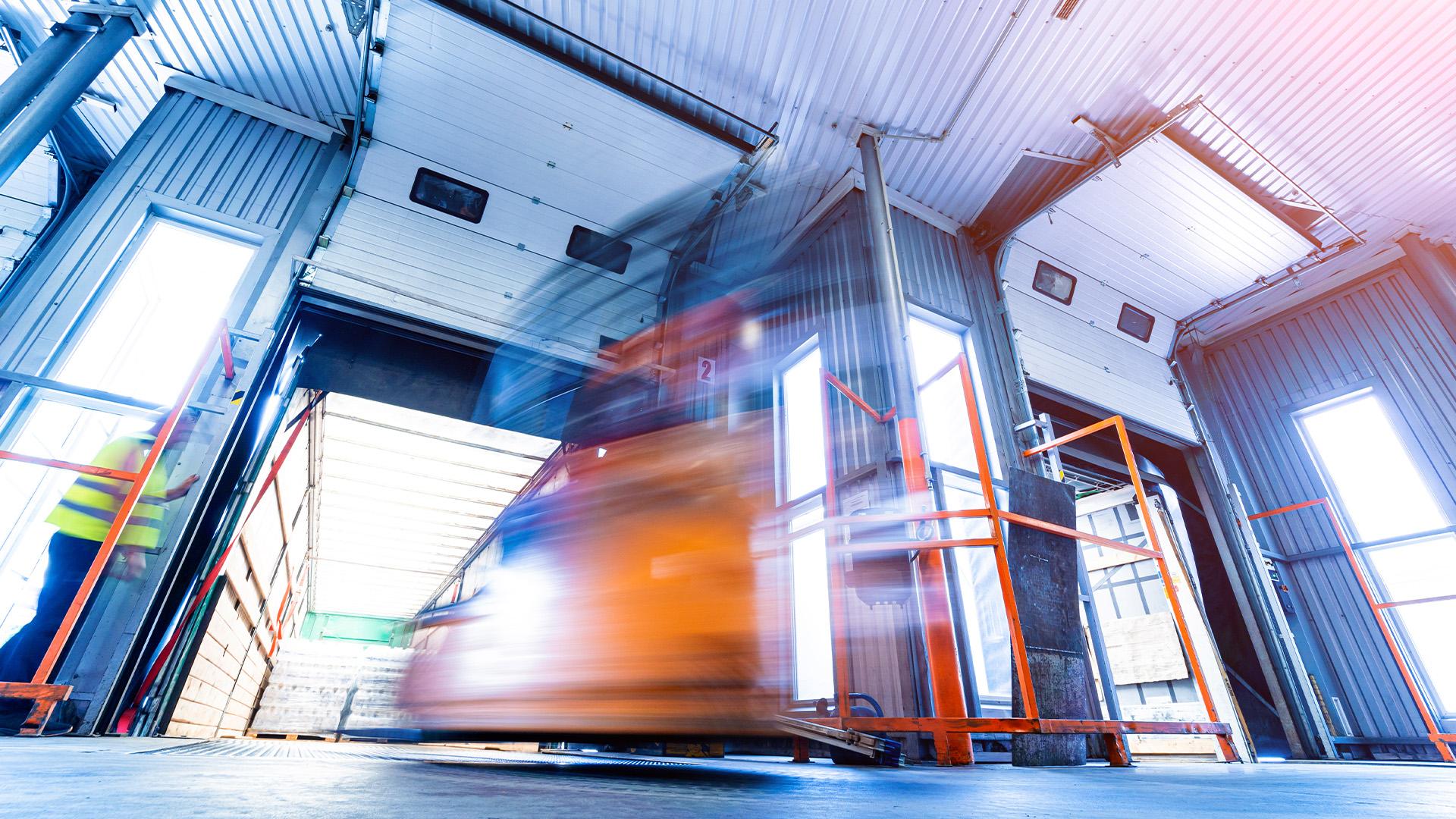
Most conversations about warehouse automation start further downstream such as sorting, storage, picking, fulfillment. Unloading rarely gets the same attention, even though it's where every inbound shipment actually enters the building. Whether goods arrive shrink-wrapped on pallets or cases stacked directly on top of each other, how they come off the truck determines speed, safety, and accuracy in the warehouse.
Floor-loaded containers are impacted the most. These are trailers packed wall to wall and floor to ceiling with cases and no pallets underneath. Floor-loaded containers introduce a high level of physical demand and unloading speeds are slow. They are becoming more common as shippers look for ways to control freight costs.
The Floor-Loading Container Shift
Floor loading exists because it solves a real cost problem. A pallet takes up space a trailer could otherwise use for product, and pallets need clearance between them to load and unload safely. Removing both increases cube utilization, which lowers the shipping cost per item. For international shipments, this cost savings is hard to ignore. International shipping restrictions require pallets to be built from wood treated to prevent the spread of pests and disease, and this requirement pushes floor loading as the more practical option. Irregularly shaped or oversized goods, such as appliances, carpets, tires, and bagged products, tend to floor-load well too.
The trade-off shows up on the receiving end. Loading and unloading a floor-loaded container takes considerably longer than working a palletized load, which means higher labor costs and a much harder physical job. Reaching into a trailer packed floor to ceiling, often in extreme heat, to lift and reposition boxes by hand is fundamentally different than pulling pallets with a forklift.
Floor-Loading Containers and Warehouse Operations Impact
The physical demands of floor-loaded unloading translate directly into safety data. The loading dock is widely cited as one of the most dangerous areas of a warehouse, associated with roughly a quarter or more of all warehouse accidents. Bureau of Labor Statistics figures show warehousing and last-mile delivery carrying the highest rate of serious injury in any sector, at close to four cases per 100 workers. Add trailer interiors that can climb well past 100 degrees during summer months, and the ergonomic strain of repetitive lifting and reaching, and the dock becomes a concentrated source of both injury risk and lost productivity.
Under fully manual conditions, the common approach is step stools and additional labor, whether that's in-house staff or a lumper crew. A reasonable benchmark is around 150 cases per hour per person, with a four-person team clearing roughly 600 cases per hour. Case rates vary dramatically based on product mix and container conditions. It works, but it asks a lot from the people doing it. Adding more people for faster unloading is not possible due to the physical constraints in a trailer.
Ergonomics and Safety
Safety and ergonomic exposure don't always show up as a single dramatic incident. They show up gradually, in workers' comp claims, in turnover on the hardest physical roles, in the difficulty of staffing a job that wears people down. Among the organizations already moving on this, particularly the largest fleets and highest-volume operations, safety and ergonomics are consistently cited as the primary reason for adopting better unloading equipment, with unloading speed and labor savings treated as a secondary benefit rather than the main case. That's a meaningful signal. The operations already running at scale are prioritizing floor level container unloading for reasons beyond an easy ROI. Smaller facilities may simply lack the data to see the same risk as clearly.
The Cost of a Slow Container Unload
Beyond safety, a slow container unload carries financial exposure. Several fee categories can accumulate when a container or trailer isn't cleared quickly, ranging from –
demurrage, charged by the ocean carrier when a container sits at the port past its free time
detention or wait time, when a driver is held at the dock beyond an agreed window, often two to three hours
drop charges, when a trailer is left rather than unloaded on arrival
and storage charges, when goods sit in a yard or warehouse space longer than allotted.
In one documented case, a facility relying on imports and floor-loaded containers was paying more than $200,000 a year in demurrage fees. After adopting unloading technology to move goods out of containers faster, that figure went to zero.
The Range of Container Unloading Equipment Available
Unloading technology today spans a spectrum rather than a single leap from manual to automated.
Fixed-Height Conveyors
Fixed-height conveyors, including powered or gravity flexible roller conveyors and telescopic belt or boom conveyors, are the first step above fully manual unloading. They let a team move goods out of the trailer with less space restriction and can feed downstream systems like scanners or sorters. Productivity typically lands in the 600 to 900 cases-per-hour range, a modest gain over manual work. The ergonomic benefit is limited. Workers still lift boxes from the floor to conveyor height or reach overhead using step stools, and the crossover panels on flexible roller conveyors create pinch points that require careful training.
Portable Ergonomic Conveyors
Portable ergonomic conveyors are semi-automated, worker augmentation systems. This conveyor moves to the worker's ergonomic power zone, roughly between the belt buckle and chest. The worker is sliding the box to the conveyor with this system rather than requiring the worker to lift a box onto the conveyor. A pivoting front conveyor combined with an elevated operator platform lets a single worker reach all four corners of the container. These systems typically include emergency stops, hand-presence sensors, platform pressure mats, and guard rails as standard safety features. Productivity roughly doubles what manual crews or robotic arms achieve, with rates near 1,000 cases per hour per operator and up to 3,500 cases per hour reported with two operators working together.
Full Automation
Fully automated systems, using six-axis robotic arms or large mobile robotic platforms, remove ergonomic risk entirely. Workers are not required to enter the container. Robotic arm systems generally match manual four-person output at around 600 cases per hour, so the gain is in worker safety rather than speed.
Data Quality Starts at the Dock
Container unloading is also the earliest point where a warehouse can get inventory data right, or wrong. Boxes and contents can be damaged during manual unloading. Whether from a fallen wall of product or from being tossed rather than placed. This damage can compromise the label or barcode before the item ever reaches a scanner. Presenting boxes onto a conveyor in a consistent, correct orientation supports accurate downstream reads without slowing the unload itself. In a floor-loaded trailer, packed as a three-dimensional stack of mixed sizes and weights, converting that chaos into a single, orderly flow of product is what makes efficient automated scanning, sorting, and storage possible on the other side of the dock door.
What Warehouse Leaders Can Do
Warehouse managers can review unloading as a starting point rather than an isolated task in their process. A conveyor-based unloading system can begin the inbound automation journey. It can connect unloading to downstream automation through a simple mechanical and electrical interface. And none of this requires solving the entire inbound process at once.
Upgrading unloading at a handful of doors is a contained, quickly implemented project. It establishes the connection point for later phases of automation. Dimensioning weighing, bar code scanning, print and apply, automated routing systems can follow. Framed that way, unloading is the first phase of a broader inbound automation strategy, and one of the more accessible ones to start with. In a mixed-use facility, dedicating dock doors to floor-loaded unloading is a very practical way to start.
The ROI Case for Better Unloading
The return on investment for better unloading equipment typically comes from several directions at once –
fewer total labor hours per container, even when a faster process calls for more workers on the line
reduced exposure to demurrage, detention, and storage fees
lower injury-related risk and costs
better retention in roles that are difficult to staff
inbound data accuracy and inbound automation scalability
Every inventory record and downstream decision depends on accuracy. Getting container unloading right can start jump start a warehouse's inbound digital and automation process.
Explore how emerging unloading and inbound technologies are helping warehouses create safer, faster, and more accurate receiving operations. Connect with the MHI SLAM/WARP community to learn how leading organizations are turning inbound logistics into a strategic advantage.
Contributor: Stefan Friedrich, Gorbel
Reviewed by SLAM WARP Committee
- #unloading
- #Inbound Receiving
- #Automation
- #Safety
- #Automatic Truck/Container Loading & Unloading Solutions
- #Trailer Unloading
- #data
View more blogs by:
Related Content
BLOG
How Automated Receiving Enhances Warehouse Master Data
BLOG
Why WARP Matters in Warehouse Receiving

BLOG
Using SLAM Automation to Rate Shop
BLOG


